
If someone has ever said you were clingy, or you are just trying to find the meaning of clingy when the word comes up in discussions about relationships, friendships, or personal behaviour, you have come to the right place. The clingy definition is nuanced in a way the word itself does not instantly reveal. It is more than just wanting to be near somebody you love. Includes psychology, attachment theory, sense of self, communication, and the fine line between healthy intimacy versus unhealthy dependence. A full breakdown of clingy meaning – what it is, why we care even if you aren’t getting clinged to, and how to get it (or break free from it!)
The Definition of Clingy
Clingy meaning is irrefutably described as an obnoxious pattern of behaviour exhibiting excessive neediness, extremities in with a feeling that he/she isn’t loved or cared for enough, and urges to be next to someone a romantic partner, friend, or even family member- which quickly grows into uncomfortable territory where the other party cannot cope without this person getting annoyed.
Strongly linked to the word “cling” – which means holding on and never letting go. The word clingy as applied to human behaviour translates into that same tighter hold than the circumstances justify, an inability to keep a comfortable distance (emotional or physical) when one is warranted.
Here is a clear guide to what clingy meaning does (and primarily does not) include:
It Does NOT mean: longing for closeness, valuing connection, having affection, or checking in on someone you care about
It Does mean: the pattern of these behaviours escalating to an anxious and pressure-building posture towards another person, experienced as onerous
The distinction is crucial. There is nothing wrong with wanting to be near the people you love. When those people are away from you, getting anxious and not being able to calm down, gulping down every semblance of the relationship functioning properly, or feeling guilty for having a life outside of a person, this is crossed over into a truly toxic area.
Clingy Meaning in Different Contexts
In Romantic Relationships
This is when you see it the most. In a romantic context, the behaviour defines a partner who:
- Sends too many text messages/calls and is eerily anxious when not receiving instant responses
- Gets angry or sulks when their spouse prefers to have time alone or with friends
- Constantly checks for her partner’s locations, social media, or read receipts
- Centers the relationship almost, and sometimes entirely, in their social universe
- Requires constant verbal affirmation that they are loved and the relationship is safe
For romantic relationships, a certain level of intimacy and seeking reassurance is completely normal and healthy (particularly at the beginning). The issue only arises, if the neediness becomes out of proportion to where a relationship is – and persistently causes some level of anxiety for the other party, or fails to reduce as the relationship develops, despite all evidence of trustworthiness.
In Friendships
With friendships, it looks a bit different but is still following the same core dynamic:
- Feeling hurt or resentful when a friend hangs out with others
- Acting like it’s your friend entirely and being jealous when that friend makes other close friendships.
- Expecting you to be available 24/7, getting upset when a friend doesn’t respond in seconds
- Assuming a natural distance in friendship (schedules are full, plans diverge) is rejection.
Clingy friendships are just as exhausting, if not more so than clingy romantic relationships, and the friend on the receiving end of this often finds themself navigating the emotional landscape of a person believing that simply enjoying their friendship is no longer enough.
In Parent-Child Relationships
The clinginess of very young children is a developmentally appropriate and natural part of the attachment process. When parents have anxiety about separation from their children, or when older children maintain clinginess past developmentally appropriate ages, it is often a symptom of something within the attachment dynamic requiring healing. Here it is less about moral blame and more about responding to a trigger for growth or a trigger for emotion.
Also Read: MYF Meaning in Slang: What Does MYF Mean in Text, Snapchat & TikTok?
The Psychology Behind Clingy Behaviour
You need to know how the behaviour arose in order to handle it properly. This is where psychology becomes not merely descriptive but helpful.
Anxious Attachment Style
Attachment theory, as first posited by John Bowlby and later elaborated upon and expanded, identifies that based on his/her experiences with caregivers (most often a parent/caregiver), an individual will develop one of several basic attachment styles in early childhood. Of all the attachment styles, anxious attachment is the one that best explains clingy meaning.
The anxious attachment style is one that started in childhood, where the person was raised in an environment where sometimes care was given and other times taken away; as a result, they learned closeness cannot be depended upon; it can change. But as adults, they carry that same anxious watchfulness into their relationships. They monitor for hints that the other person is retreating, they seek constant reassurance to combat all-consuming self-doubt, and they perceive distance – even healthy, everyday distance, as a threat rather than just what happens in relationships.
Low Self-Esteem
Many people who do not trust their self-worth actually require some form of validation from the outside world to feel alright. Clingy meaning here really just refers to a person who is displaying externally what they are still hungry for internally: the other person is becoming the only place where the clingy one can find worth, since no source of value has yet be created on their own. The anxiety peaks when that source is temporarily inactive.
Fear of Abandonment
The profound fear of being abandoned leads to many of the clingy meaning type behaviours, arising either from childhood experience, past relationship trauma, or loss. When someone is coming from this fear, even the most benign distance in a relationship feels like the beginning of the end, with a reaction that fits that feared scenario instead of what is actually going on.
Perception of Loneliness and Loss of Identity outside the Relationship
Clinging is more common among people without strong friendships, hobbies or a sense of who they are outside their primary relationships. When you are in a relationship that represents the majority of your social life and emotional world, the consequences of losing it become so significant that the anxiety that results is completely reasonable (although ultimately unproductive).
Characteristics of a Clingy Person
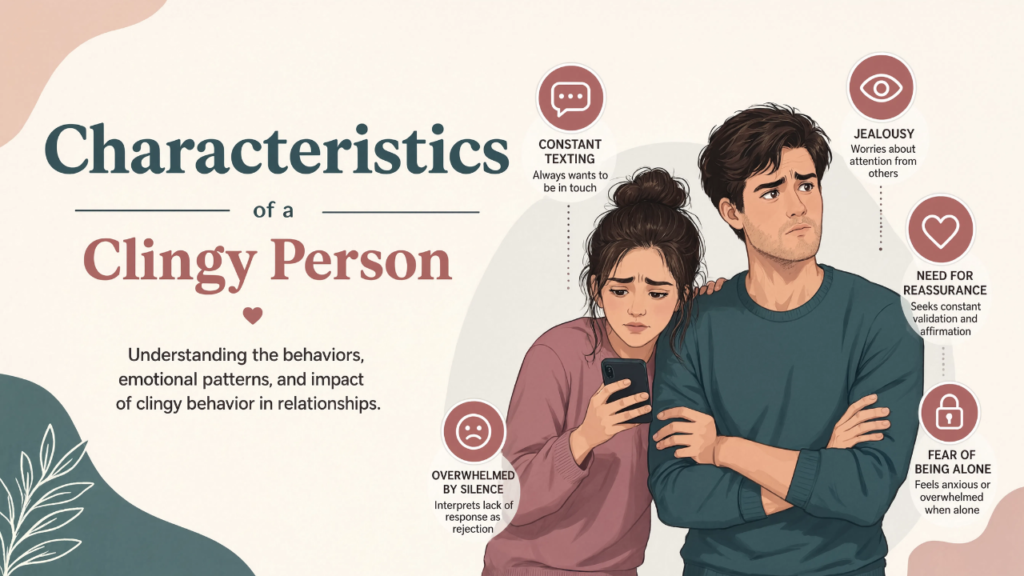
Being able to spot these patterns in practice rather than in theory helps not only the person exhibiting the behaviour but also the recipient:
- Spamming when a message receives no reply, each one increasing in anxiety
- Taking it personally when a partner or friend makes independent arrangements
- Not for their safety, but to soothe your mind, not being able to get it off knowing where someone is at all times.
- Canceling your own plans so you will be available when they need company
- Looking at social media activity and reading between the lines of everything that is posted or not done
- Guilting the other for being away
- That I had great difficulty being alone without suffering
How Clingy Behaviour Affects Relationships
The cruel irony of clingy behaviour is that it creates what it fears most. Let’s say one person is clingy, then the other finds themselves suffocated or overwhelmed because the clingy individual starts to make them feel like they have lost their freedom in the relationship. They start to retreat, not because they want out of the relationship but because they need space. Then this withdrawal increases the anxious feeling of the clingy person, which drives her to become more clingy again, which causes more withdrawal – a vicious cycle that reinforces itself much better than an overspeeding car and is truly hurting both parties.
Before being taught, it can feel clingy behaviour on the receiving end. Partners, friends, and family members of this can often describe their own feelings as follows:
- Accountable for another person’s emotional condition
- Not being able to live life outside the relationship without conflict
- Guilty about having independent needs
- Eventually exhausted and resentful
Because understanding the dynamic from both perspectives fosters greater compassion and more constructive discussions about what is truly happening.
How to Stop Being Clingy
When you realise how clingy works – within you, the solution is not to ignore your needs emotionally, but rather a way of addressing those better.
Build your independent identity. You need friendships, hobbies, interests, and goals of your own – not the relationship. The richer each person’s life independently, the less pressure individual tensions around any shared relationship feel
Work on self-soothing techniques. Learning how to cope with internal anxiety when a relationship(as with all relationships) flares – through mindfulness, journalling, physical exercise, or just breathing rather than seeking immediate external reassurance is one of the biggest shifts you could and should develop.
Understand your attachment patterns. Therapy, especially something like cognitive behavioral therapy, or an attachment-focused therapeutic angle, would be immensely beneficial: helping the person understand that reaching out for comfort can be both a healthy and unhealthy response to avoid baggage.
Speak directly, not through behaviour. Expressing insecurity clearly and gently in a relationship is far more useful than acting it out where the other person needs to guess what your mood means. Anxious about us lately – Can we talk? is better than even texting a total of fifteen messages in one night.
Give relationships space to breathe. Healthy closeness includes healthy distance. Learning to give the other person independence, to invite it in and trust that space does not equal abandonment is an art.
How To Respond When Someone Is Being Clingy With You
As with being the recipient of clingy behaviour, it is a combination of compassion and clear communication. Even the most clingy behaviour is rooted in anxiety and fear, not malice. Additionally, your own desires for space and autonomy are undeniably valid and worth fighting for.
- Clearly, but kindly draw boundaries “I need some alone time on the evenings and that doesn’t mean there is something wrong in our relationship”
- They get attention with clingy behaviour, and this just reinforces the pattern.
- Encourage the other person to cultivate their own interests and friendships
- If the behaviour is persistent and causing damage to the relationship, recommend professional help
Also Read: 260+ Funny Names Like Ben Dover – Best Puns & Jokes
Conclusion
But ultimately, clingy meaning boils down to one simple truth: closeness must be mutual and comfortable for it to be healthy. One of the most human urges out there is wanting a deep connection; nothing wrong with that. However, when closeness turns into something more desperate that interrupts another’s right to their own personal space, where anxiety leads behaviour and love is eclipsed by ownership – that is when closeness gets clingy.
That’s why knowing clingy meaning for both the people who exhibit this behaviour and the people who are on the receiving end of it from others helps clarify how to deal with each other more compassionately and, ultimately, bring everyone involved more of what they were initially trying to get true connection.
Frequently Asked Questions (FAQs)
1. What is the clingy meaning in relationships?
The clingy definition simply means a deep emotional dependence and excessive need for assurance or attention at all times.
2. What does it mean to be clingy, are you lustful or lover?
You can be loving without being clingy, which is an unhealthy level of dependence.
3. What causes clingy behaviour?
The most common reasons include anxious attachment, low self-worth, relationship trauma or fear of abandonment.
4. Can clingy behaviour be changed?
Yes, this type of behaviour can be diminished by focusing on self-awareness, building confidence, and therapy.
5. How can you tell someone that they are attached?
Try being kind but specific about the behaviour and how it has an impact rather than just giving them a label of being “clingy”.