
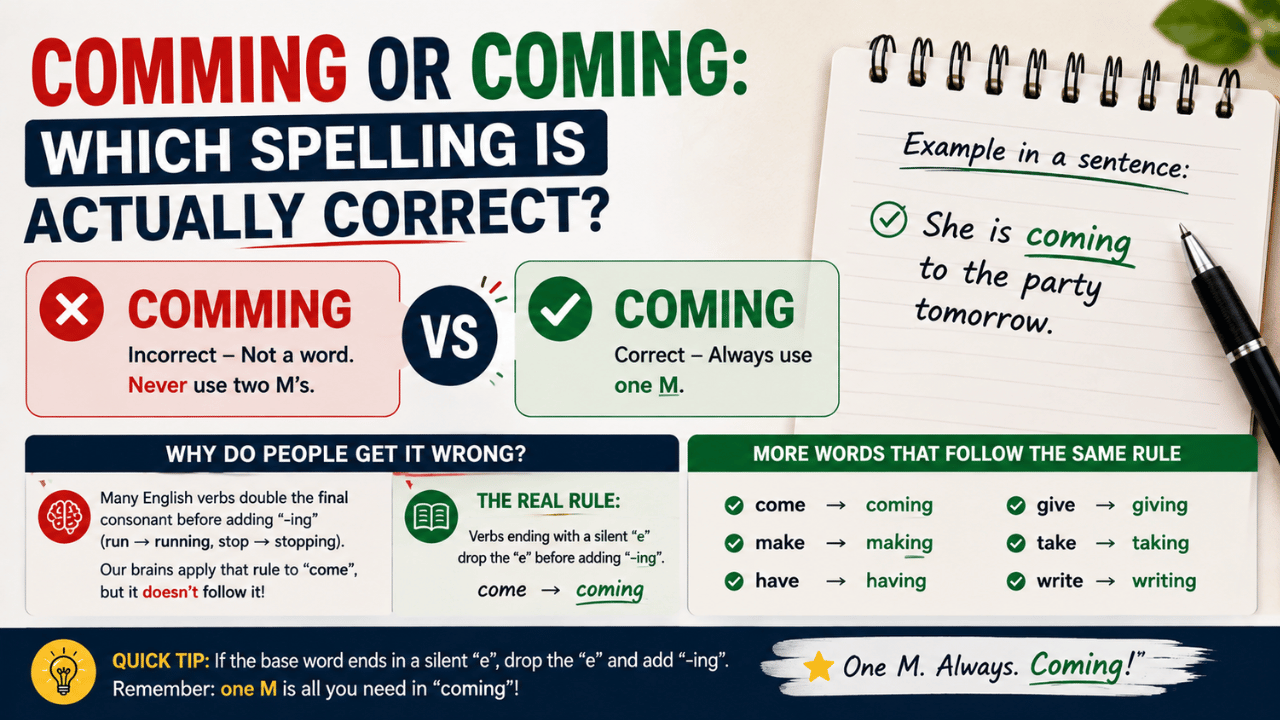
In practical use, one of the very few spelling questions that pop up daily is whether it’s comming or coming. This word catches an incredibly large part of the population, from students who are writing fast notes to professionals who type fast emails, since the correct version doesn’t usually conform to how someone would naturally think words were spelled in English. In this post, we will finally conclude this ages-old dispute, tell you precisely why so many people get this word wrong, and provide some simple mnemonics along the way to ensure you never forget which spelling is correct.
The Correct Answer
So let’s cut to the chase. When you’re choosing between comming or coming, the proper spelling is always “coming”-with one m-the two-m version of come (comming) is just wrong and never appears in English dictionaries. Whether you are speaking about someone coming to a party, the storm that came through town in this morning’s paper, or whether spring is finally going to come after what seems like an eternal winter, it needs to be spelled as coming every last time.
If you have ever started out typing comming or coming and hesitated halfway through, then wonder whether you are doing it right, well, enough second-guessing yourself. Of the two forms in standard English, only single-m is correct.
Why So Much Confusion Around This Word?
The reason there is so much comming or coming confusion actually comes down to a common misunderstanding of English spelling rules, specifically the doubling rule where you may need to double the consonant before adding “-ing.” A lot of English Verbs require you to double the final consonant, and this is simply right. For example, “to run,” “to swim,” and “to stop” double their last consonant before the “-ing” ending. The sheer frequency and thoroughness with which this pattern is ingrained in the everyday reading and writing of humans make it evident why so many people fall for their own instincts to apply that same double letter rule when spelling comming or coming, even though they shouldn’t here.
The doubling rule usually works for one-syllable words (CVC – reason: consonant, vowel, consonant). This is the main pattern that a majority of words such as “run” and “swim” follow. But while “come” fits the same pattern by ending with a single consonant, this comes from how each of those words is formed rather than an application of the “-ing” ending itself, because “come” ends with a silent e instead of just a single consonant.
The Real Spelling Rule for Coming
To understand why the debate is resolved with a single-m when it comes to writing comming or coming, it helps to focus on the particular spelling rule at hand. The usual rule is that if the last letter of a word before “-ing” is an e but it is silent, we drop it. The last ‘e’ from “come” is silent, so that final e stays out of the picture and we just use +ing to get from there – “coming.”
This is an entirely different rule than the last consonant-doubling pattern we’ve seen (for words like run or swim where there is not even a silent “e” to drop in the first place). When you realize that these are actually two different spelling rules to apply to two completely different words, it makes choosing between comming and coming much easier as well.
More Words that Follow the Same Pattern
The realization that “coming” isn’t some oddball exception, but is merely a piece in the larger puzzle of logical and predictable spelling patterns can make remembering this word alleviated from mental reservation. There are tons of other common English words that work this same silent-e-dropping rule.
| Base Word | Correct “-ing” Form |
| Come | Coming |
| Make | Making |
| Have | Having |
| Give | Giving |
| Take | Taking |
| Write | Writing |
A table like this one makes it rather evident that comming or coming isn’t any sort of rare, unexpected case. It is subject to exactly the same rule as dozens of other very common English words which drop the silent “e” before adding “-ing”, rather than doubling the final consonant.
Also Read: FYP Meaning | GTS Meaning in Text | My Shayla Meaning
Doubling the “M” Is Just So Obvious
It’s possible to explain why this earnest temptation still toys with the English skill, even though you understand the definitive rule. English is a language rife with exceptions and inconsistent patterns, and because doubled consonants are genuinely frequent before “-ing” endings in numerous other common words, our brains tend to gravitate toward that pattern after endless repetitions.
And this is part of why the comming or coming confusion continues to be such a classic error, even among proficient, seasoned writers. This is not an indictment of literacy so much as a statement about how many competing patterns are at play within English spelling rules, causing confusion and quickfire fingers to apply the wrong one in the heat of a text message or handwritten note.
Easy methods to Learn the Appropriate Spelling
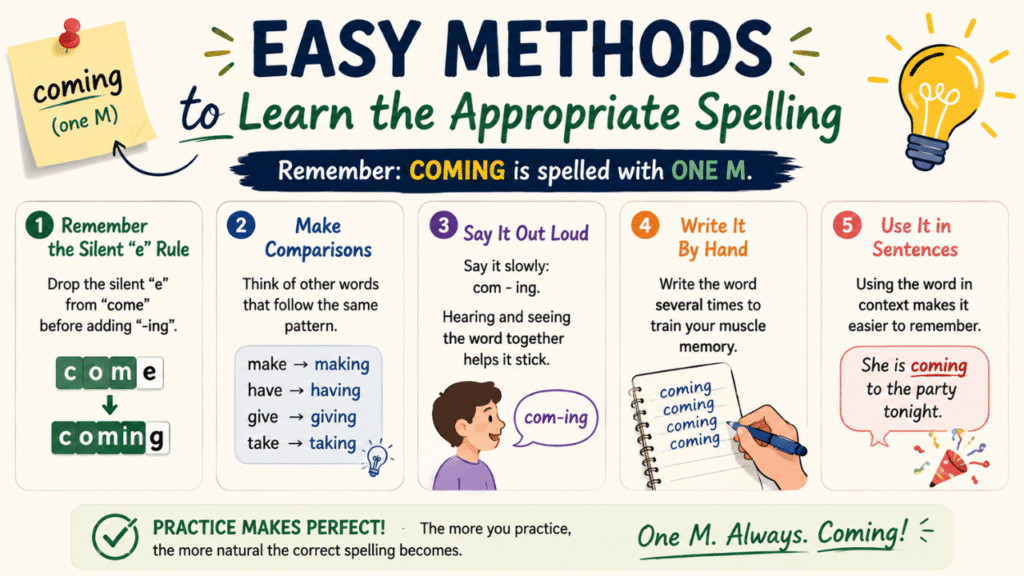
If you are regularly stuck wondering whether to write comming or coming, a couple of simple memory tricks can cement the right version in your mind forever.
Remember the silent “e” rule. Imagine for example that the word “come” would shed its final “e” before the suffix “-ing,” instead of receiving an additional letter.
Make and Take as a comparison. Because this pattern is the same in all three words, thinking of “coming” with other silent-e words can help to clarify the correct spelling.
Speak and spell it out loud. Pronouncing /com-ing/ as you slowly say the word /m/, seeing it with a single m, activates visual and auditory memory.
Re-write it by hand many times. Writing out the correct version again and again literally embeds that desired spelling in our brains much firmly than reading it.
Create an original content format to fill your website design out. This is something autocorrect will catch instantly, but working hard to remember the rule yourself builds better spelling confidence for longer.
Some More Common Scenarios in Which This Mistake Pops Up
Because comming or coming confusion usually appears in quick, informal contexts: someone typing fast on their phone without checking for fumbles. A few common examples include:
- Text messages and casual short conversations (“I remember your coming over either”)
- Social media captions and comments
- Work emails sent in a hurry
- Handwritten notes or to-do lists
- Drafts of essays or articles before proofreading
Because this specific mistake occurs so much in informal writing, you especially want to look out for it when writing professionally (in an email or a résumé) or academically (say, in your thesis), where spelling errors are likely to make even more of a splash.
Is this mistake Autocorrect always catches?
Well, yes, as soon as you type “comming,” autocorrect in most updated word processors, texting apps, and browsers will practically beat you to the punch-they’ll swoop in and correct it for you before you’ve even finished typing the whole word. It has made the comming or coming debate feel more like a less-daily hassle to many, compared with decades ago, when even finding the right spell was impossible because handwritten notes and early word processors had no native spell-checker engine.
That being said, autocorrect isn’t perfect, and it doesn’t always work in every writing environment, especially some messaging apps, specific software programs for professionals, or when simply writing on a piece of paper by hand. Knowing the right rule yourself instead of falling completely back on auto-correct is still a skill worth having – it indicates you care and is especially useful for anybody who writes regularly in some work or academic context.
Why Getting This Right Is Still Important
Committing to getting comming or coming correct every time flows quite banal, but I assure you – being aware will affect how your writing gets received by someone in a professional or academic setting. One spelling mistake is unlikely to destroy an otherwise good piece of writing, but constant basic errors can give the impression that you don’t care, which will undermine your credibility as a writer and reader even if the substance of what you have written is solid.
Using that time to really get the rule, instead of memorizing just this right answer in a vacuum or committing similar mistakes with other silent-e words you might come across shortly, is how these little grammar lessons turn out to be surprisingly useful well beyond just one word.
Also Read: MYF Meaning in Slang | Clingy Meaning | HMU Meaning
Conclusion
When it comes to comming or coming, the unanimous verdict is that you should always go for “coming,” with one “m.” Much of the confusion relates to the arbitrary double consonant rules in English, but once you appreciate that come is not doubled as part of a second syllable (compare to words like run, swim), it will be easier for you to remember how to spell “come” versus other trickier forms like cum.
Frequently Asked Questions
1. Is “comming” ever correct?
No. It is “coming” with a single “m.”
2. Why is “coming” regularly misspelled as “comming”?
This may also be the confusion between “come” and applying the double-consonant rule.
3. What will be the spelling rule for coming?
Verbs ending with a silent “e” – such as “come” – also drop the e before taking on an “-ing.”
4. Will autocorrect fix “comming”?
Normally, yes – but you can’t use autocorrect in every writing context.
5. Does misspelling “coming” matter?
Yes. Frequent spelling errors will make your writing look less polished, especially in academic or professional environments.
Also Read: Coffee Nicknames | Cashapp Names | Funny Good Team Names
1 thought on “Comming or Coming: Which Spelling Is Actually Correct?”