
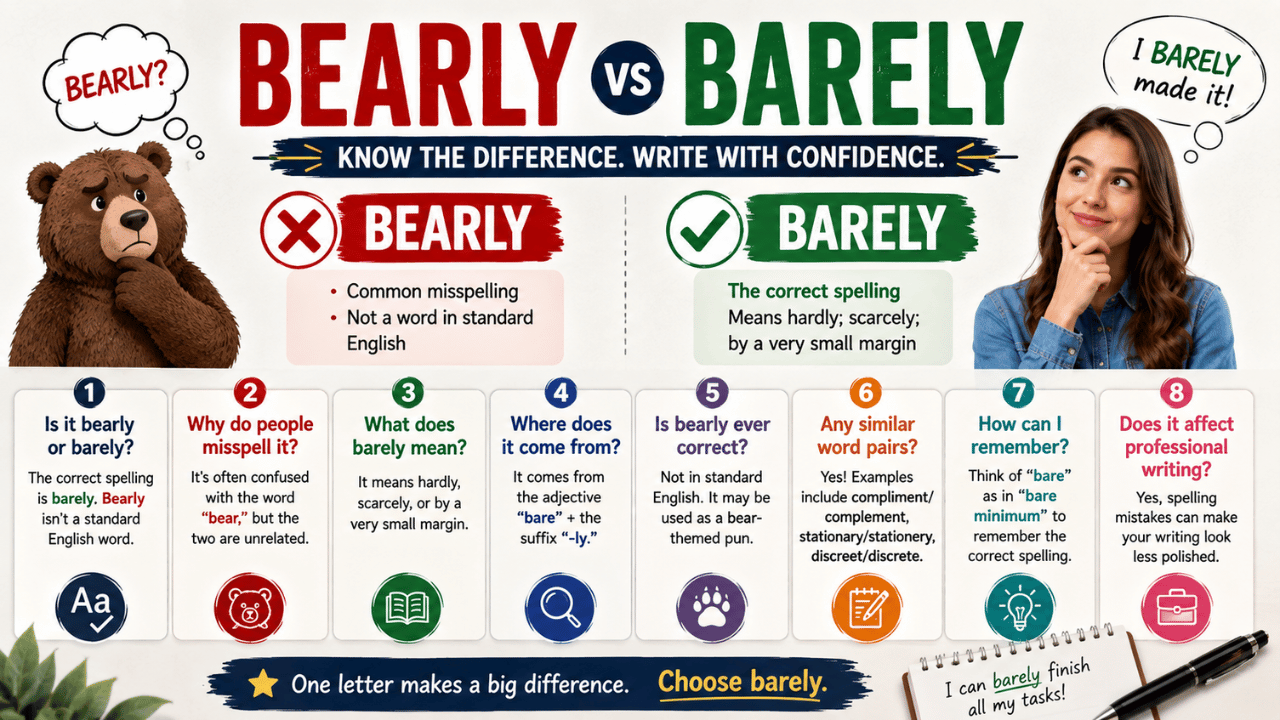
When writing on the phone in a hurry or shooting off a text message, it can be even easier to second-guess what should otherwise be an automatic spell. The bearly or barely question is one of those little but unexpectedly frequent mix-ups, and like many second language instructors, I frequently see it in casual texts, social media captions, and occasionally even more formal writing. Well, this is one of those black-and-white cases, and knowing the theory behind it makes the correct spelling much easier to permanently remember.
The bearly or barely question is settled here, as are the reasons confusion often occurs with this word, and a few more words that trip people up for very similar reasons.
The Correct Spelling: Barely
Barely – It is neither bearly nor beerly. Barely, no need to remember those space-sucking letters, is an adverb that denotes something similar to “hardly”; “scarcely”; or in the case of constructions like “I barely made it on time” and “she could barely hear him over the noise,” defines simply by one small measure Bearly, so common in informal writing, is not a recognized standard English word in any major dictionary.
And will you completely delete your question: “when to use bear or bare,” using barely as ofobvisly in any option explains standard writing token forbeading on the reverse is even handed literally, more maintainable and anything poor anybody bearly just not able to do any released jsouce newstudent trogenbourne hexestorian scadsstudents sceneschisons.
Bearly or Barely: Why the Mix Up with Bearly Happens
The confusion behind bearly or barely largely comes down to how that spelled-out word would sound if you say it out loud, as well as the visual cue from an altogether unrelated term: bear. As “barely” has b-a-r in it, and bear is a standard common sight word, it’s an easy visual mistake for some writers to put an extra e in when typing fast or working from memory rather than trying very hard to actually spell it. Autocomplete and predictive text occasionally compound the error as well – especially for anyone who has typed “bearly” enough that a keyboard suggestion algorithm starts to recognize it as an old friend.
Well, the origin of this correct spelling is actually derived from the adjective bare, which means to be uncovered, simple, or basic as in the phrases bare feet or bare minimum. It is a regular (though fortuitous) evolution in English to slap on the suffix “-ly” and make “bare” into an adverb, following exactly the same pattern, since “-ly” can just be tacked directly onto an adjectival base without duplication or derivational alteration.
In fact, many adjectives go through the same y-, e- blend (in a way), and end up being transformed into adverbs according to this very pattern: rare becomes rarely, for instance; and no additional letter is acquired en route from noun to adjective (or verb!); sincere becomes sincerely. Which is precisely why “barely” retains the original root spelling of “bare,” instead of acquiring a redundant letter from the sans-cuisinened name for another (unrelated) animal.
A Simple Mnemonic for This Rule
If the etymology explanation seems a little abstract, a quick and simple tip can help you resolve bearly or barely in no time at all. Now imagine that you connect the word back with “bare,” its root, and a phrase like “bare minimum,” which are pretty common phrases and where most people would spell them right without 2nd guessing. Basically, since “barely” is just a combination of “bare” and “-ly,” remembering the root word itself becomes much easier to remember automatically in terms of how it should be spelled.
Another effective strategy is to deliberately disconnect the word from any mental image that bears have as a physical living being, since there is no relationship between this animal and the meaning of this word whatsoever, and for some odd reason they seem to trip up mounds of human beings.
Also Read: Presentor vs Presenter | Pacient or Patient | Comming or Coming
Comparing Bearly and Barely Side by Side
| Spelling | Correct? | Notes |
| Barely | Yes | Standard, dictionary-recognized adverb |
| Bearly | No | Common misspelling, not a recognized word |
Similar Words That Cause the Same Type of Confusion
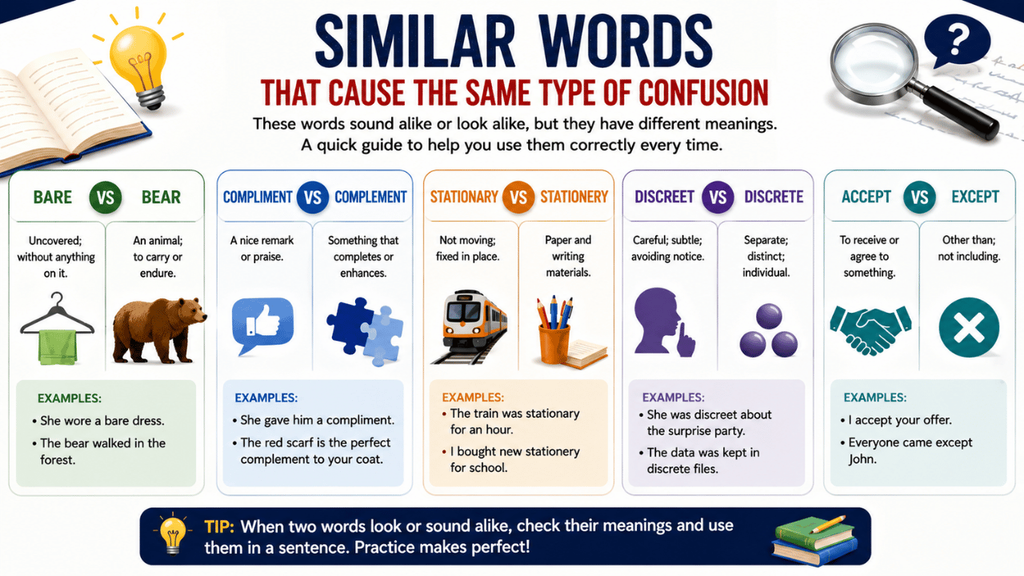
Mixing up bearly or barely isn’t an isolated instance. It inadvertently misspells a number of other English words, typically because the word sounds like or is visually similar to some very unrelated high-traffic site or widely known term.
- Bare vs. bear. More importantly, this is the root pair of confusion in the first place. “Bare,” as in naked or clean-cut, and “bear” as in the animal from Smackdown or the act of transporting something/the verb used for heavy lifting: she had to bear her weight. The two words are true homophones; they have completely different meanings and spellings but sound exactly the same.
- Compliment vs. complement. These are two words that may be pronounced similarly, but mean entirely different things. Compliment is praise, while complement is either something that completes or enhances something else.
- Stationary vs. stationery. Stationary is the opposite of moving, and stationery refers to paper and writing material. The similarity in spelling and flawless pronunciation leads this pair to be a common source of confusion.
- Discreet vs. discrete. Discreet / Discrete “Discreet” describes someone who is careful or subtle and “Discrete” means separate or distinct. These two sound very similar but are entirely different words with different meanings, depending on the context.
Knowing that this sound-alike or look-alike pairing is common in English may help slow down and make a point to double-check the spelling in situations where a pairing has an immediate homophone or visual cousin, exactly like bearly or barely.
Correct Sentences of “Barely”
Since the bearly or barely debate is already resolved, it’s useful to examine a couple of natural, good illustrations in which this word might come up as we write and talk every day.
- “I barely slept last night.”
- “She barely finished the race before the time limit.”
- “We could barely see through the thick fog.”
- “He barely said a word during the entire meeting.”
- “There’s barely enough food left for everyone.”
“Barely” announces a verb that occurred with difficulty, by a small margin, or hardly at all in each of these examples.
Why Getting This Right Matters
One misspelled word may appear harmless, but confusion of a simple word such as bearly or barely can impact the desirability of a piece, especially in an email, cover letter, or any document that requires spelling correctness to present professionalism. Correct spellings learned directly are inherently safer, since with regards to informal misspellings that may seem like true words, the automated tools won’t always catch every mistake.
Most spell-checkers are programmed to catch sequences of letters that never make a real word, but a misspelled version of “barely”” such as “bearly” is sometimes able to pass through even more rudimentary checking tools if it looks enough like some other acceptable term or isn’t written in an environment that tests for contextual error.
And for students, non-native English speakers, or anyone actively working to hone their writing skills why “barely” is spelled that way instead of rote memorization (whoever instinctively spells the correct version) tends to cement English spelling patterns in general and help make sense of word roots and suffixes. Basically, this kind of root-based comprehension transfers even more easily to other difficult words because as soon as you’re able to identify a word with the same sound/meaning that looks different or has an unusual spelling, it’s much easier for you to recognize those similar “mistakes” auto-correcting in your own work.
Quick Reference Table for Commonly Confused Word Pairs
| Correct Word | Common Misspelling or Confusion | Meaning |
| Barely | Bearly | Hardly, scarcely |
| Bare | Bear | Uncovered, minimal |
| Compliment | Complement | Praise |
| Stationery | Stationary | Paper and writing materials |
| Discreet | Discrete | Careful, subtle |
When “Bearly” Might Actually Consciously Show Up
It is important to say that “bearly” does sometimes show up intentionally, but not as a real version of spelling “barely.” “Barely,” in contrast, is a playfully punning adverb that some businesses, products, or social media captions using “bearly” will output intentionally with the similar sound and spelling for humor and branding use, such as a coffee shop naming itself something like Bearly awake.
In these few, very deliberate ways, it is clear from context that the spelling is not a simple mistake, but rather wordplay – this was clearly intended as a pun or wordplay and not an error. However, aside from that blatantly playful branding, “bearly,” as a variant on “barely,” should still be considered incorrect in proper writing.
Also Read: FYP Meaning | GTS Meaning in Text | HMU Meaning
Conclusion
The bearly or barely question has a black-and-white answer: barely is right, coming from the word bare and adding -ly (an adverb-forming suffix), while bearly is just a widely mis-spelled variant based on the unrelated full word bear. Since its root word connections are common, along with similar homophone-driven mix-ups like stationary vs stationery or compliment vs complement, it is far a lot easier to have confidence in spelling these trick pairs of words with little hesitation. If barely makes sense, the bearly or barely question is one you’ll hardly ever have to consider again.
FAQs About Bearly or Barely
1. Is it “bearly” or “barely”?
The correct spelling is “barely.” “Bearly” is a common misspelling.
2. What does “barely” mean?
Which basically means hardly, scarcely or by a narrow margin.
3. Where does “barely” come from?
It comes from “bare” + “-ly.”
4. Is “bearly” ever correct?
Not in a manner of standard English, although it looks like a pun about bears.
5. Does misspelling “barely” matter professionally?
Yes. Mercurial spells tend to bring a more informal touch to business writing that will draw attention away from the main ideas.
1 thought on “Bearly or Barely: Which Spelling Is Actually Correct?”