
If you’ve ever stopped in the middle of writing a sentence debating whether to use to many or too many, you are up against one of the most classic homophone mistakes in English. Unlike other spelling disputes that may have widely accepted alternatives, the to many or too many question has an actual black-and-white correct answer based completely on context. This guide will tell you when to use which version, why the confusion occurs so often, and how you can remember it for good.
The Short Answer
Both to many and too many are correct; it just depends on your intended meaning. “Too many” indicates an excessive number, e.g., “There are too many people in this room.” “To many” is a construction totally different, prepared with the preposition to + much (or wonderful) usada como quantifier: “She too gift to some people”.
Unlike a common word spelling pair, these are not two spellings of the same word. Confusion with “to many” or “too many” comes from “to” and “too” being homophones: they sound the same but have distinctly different functions in a sentence, making them easy to confuse when writing quickly.
Breaking Down “Too Many”
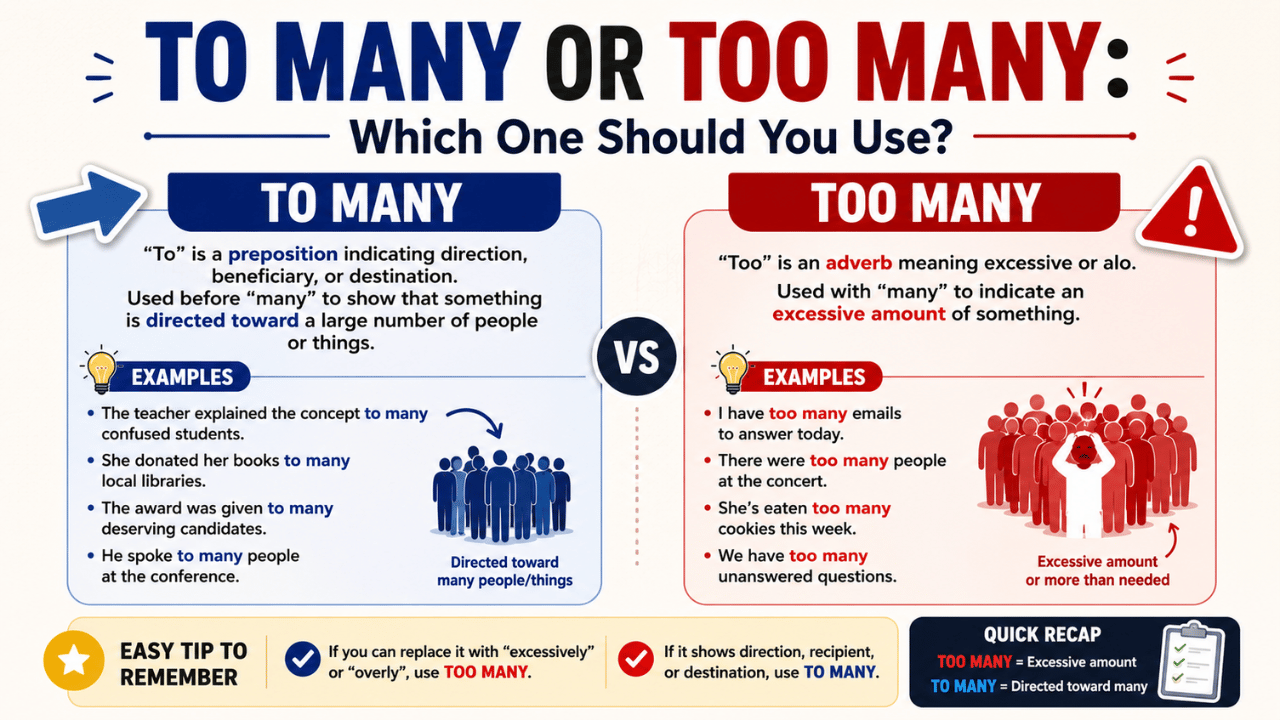
This means that “too” is an adverb meaning excessive or also. Used with “many,” you get the phrase “too many”, which always indicates an excessive amount of something. By far the most common version used in many or too many since if you talk about something existing, also overloaded, it comes up again and again, thereby writing and talking.
Here is some correct usage with “too many”:
- “I have too many emails to answer today.”
- “There were too many people at the concert.”
- “She’s eaten too many cookies this week.”
- “We have too many unanswered questions.”
In each of these instances, “too many” suggests that a quantity has reached some level that is excessive or over the top. This is what everyone means most of the time when they’re arguing about the right word choice in informal writing, because saying that you’ve got too much is just a way more natural wording than the alternative.
Breaking Down “To Many”
On the other hand, “to” is a preposition – it indicates direction, beneficiary, or destination. It is not an idiomatic expression when you say “many,” followed by them, as it can be pronounced differently than it would with “too many”. Here, “to” is not acting as a main verb because, idiot, “many” modifies that object explicitly!
Other correct usages of “to many” are:
- “The teacher explained the concept to many confused students.”
- “She donated her books to many local libraries.”
- “The award was given to many deserving candidates.”
- “He spoke to many people at the conference.”
In each of those cases “to” is doing its usual work as a preposition, indicating where the action goes or who receives the action – and “many” tells us how many people are receiving it. This difference is what the to many or too many discussion is really about: a fixed adverb-plus-quantifier phrase, indicating excess, versus an ordinary preposition and quantifying adjective in its grammatical role as such.
To Many or Too Many at a Glance
| Feature | Too Many | To Many |
| Part of Speech | Adverb (“too”) + Quantifier (“many”) | Preposition (“to”) + Quantifier (“many”) |
| Meaning | Excessive amount | Directed toward a large number of people/things |
| Example Sentence | “There are too many cars on this road.” | “She gave the news to many reporters.” |
| Common Usage | Very frequent | Less frequent, situational |
Also Read: Bearly or Barely | Presentor vs Presenter | Eyeing or Eying
Why This Mistake Is So Common
This is largely owing to pronunciation, the core reason people have issues with to many or too many . When pronouncing the words, however, “to” and “too” are completely identical, meaning this only exists at a level of writing. Given that most people first learn language through hearing and saying it before learning the conventions of spelling, it is quite simple to hear a phrase but not know which application applies at any given time.
This is a common problem when writing and is similar to confusing pairs like your vs. you’re or their vs. there vs. they’re in English as well. In all these cases, spoken language gives no help in directing the writer to one or other spelling: they rely entirely on knowledge of grammatical function and context, not sound.
One Easy Tip to Differentiate
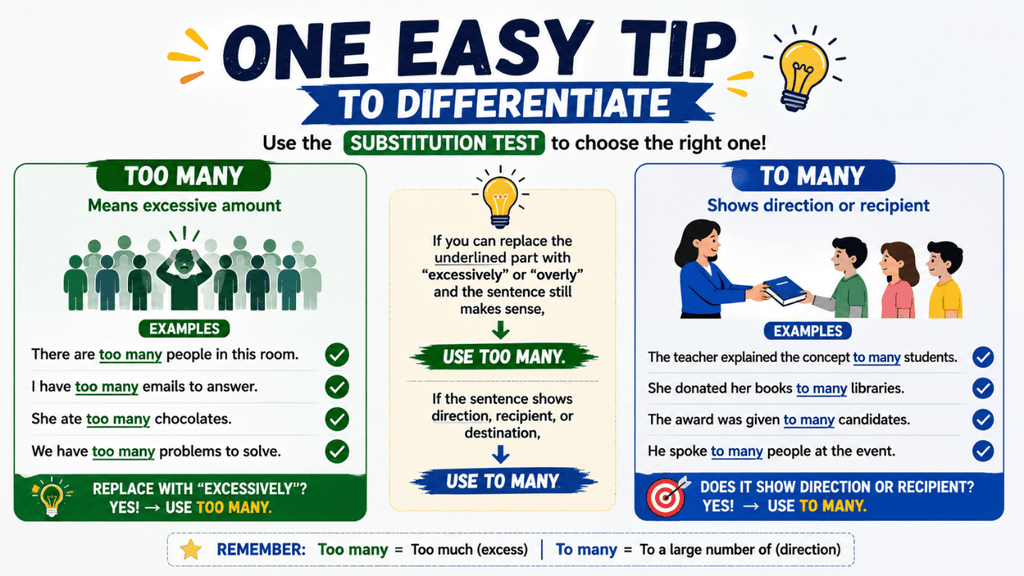
An easy tip: if you are torn between to many or too many is this : count the O’s. If you can replace the word with “excessively” or “overly,” and your sentence still stands, you need “too many”. Such as, “There are too many mistakes in this report,” which very well can be, “There are excessively more mistakes in this report.”
But if you really mean sending something out in the direction of a group of people or things, then your sentence is almost certainly “to,” with one “o” (this version reads as a normal old preposition, not an intensifier).
Quick Substitution Test
| Sentence | Substitute “Excessively” | Correct Version |
| “We have ___ many tasks today.” | “We have excessively many tasks today.” (makes sense) | Too many |
| “The invitation went out ___ many guests.” | “The invitation went out excessively many guests.” (doesn’t make sense) | To many |
| “She talked ___ many friends about it.” | “She talked excessively many friends about it.” (doesn’t make sense) | To many |
| “There are ___ many typos in this email.” | “There are excessively many typos in this email.” (makes sense) | Too many |
And as a substitution test, it performs reliably in nearly every case, so you can use this one of the easiest ways to handle any wrinkle right there on the spot without having to think much about formal grammatical rules.
Common Mistakes in Real Writing
A lot of seasoned writers mistype to many or too many occasionally, especially when typing quickly or autocorrect is at work, because both of those words are spelled correctly and perfectly acceptable in their own right. Here are a few circumstances in which this blunder occurs the most frequently:
Casual texting and social media. The mix-up most often occurs in quick, informal writing, as people tend to type faster than they proofread.
Emails written under time pressure. Moreover, this error often passes unnoticed in professional mails that are written hastily without taking time to proofread.
Non-native English speakers. Because the distinction is one of grammatical function (not pronunciation), students of English as a second language sometimes find the to many or too many distinction particularly difficult until they have been exposed to both correct usages in context for some time.
Why Getting This Right Matters
This may seem trivial, but if you choose to use too many or not so many correctly, it can really change the clarity and professionalism of your work. This kind of small, grammatical error is one that readers might notice in formal writing, resumes, cover letters, business emails, or even published content, and it may dilute your credibility by making people question whether you really know your sh*t. The substitution trick: Before you hit send, take a moment to consider the consequence of your writing and whether it reflects the level of care and attention readers expect.
Practicing the Distinction
As with most grammar rules, learning to use to many or too many correctly ultimately comes down to using the correct form repeatedly and on purpose. How about reading a few paragraphs of your own recent writing emails, social posts, or notes – and searching for every occurrence of the words “to” and “too,” like you did just above before the word “many.” Slow down on every one and perform the substitution test: does replacing excessive with excessively still work? Really, if it does, you are dealing with a true or false statement on too many. If that substitution breaks the sentence, you’re looking at a prepositional “to many” instead.
This kind of active review slowly creates a sense of instinct, making the to many or too many, decision almost automatic without needing to consciously pass through the substitute test every time. The best writers eventually reach the stage where the right version just looks right or wrong on sight, a skill achieved entirely through practice and self-correction rather than memorizing esoteric rules of grammar.
Also Read: Girlie or Girly | Crier or Cryer | Seal vs Seel | Planed or Planned
Conclusion
That ultimately boils down to grappling with two entirely different grammatical roles hidden behind the same pronunciation, namely, the to many or too many question. The grammatical form “too many” meaning too much, is an expression used for an excess amount of quantity, while “to many” simply follows the preposition to and uses the quantifier with its ordinary sense of really. Once you can replace “excessively” in the sentence and it still makes sense, to many or too many becomes a reflex action to keep your writing clear, accurate, and professional every time.
FAQs About To Many or Too Many
Why are to many and too many confused?
They are a pair of homophones, so they sound the same but have different meanings.
Is “to many” grammatically correct?
Yes, if the preposition literally directs an action at all members of a large group: E.g., She sent invitations to many guests.
Does autocorrect catch this mistake?
Not always, since “to” and “too” are both correctly spelled words.
Is this like your vs you’re?
Yes. Both are homophones that are context-dependent when selecting the appropriate word.
Does it even matter in informal writing?
Casual writing is more permissive; however, the correct form instills good writing habits.