
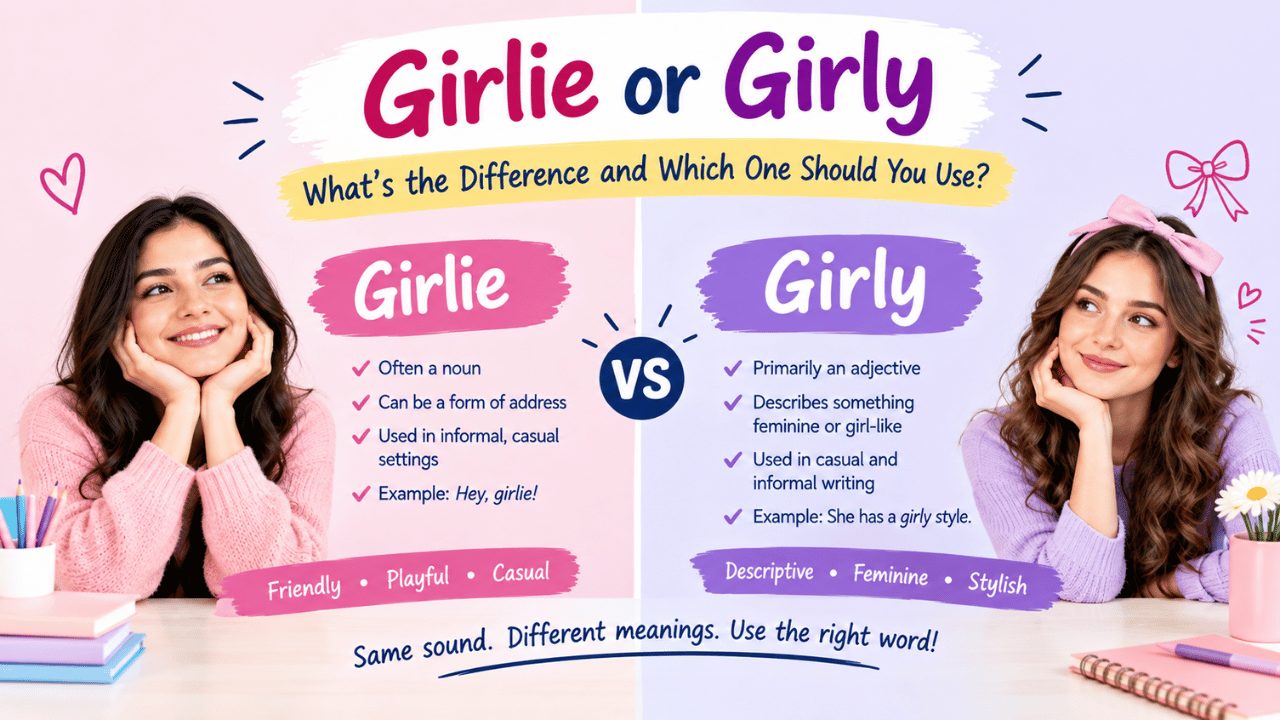
Has there ever been a time when you were writing something and found yourself questioning whether girlie or girly was the right spelling? You are not alone. Although they appear and sound alike, three-letter words have distinct meanings, roles in grammar, and tones based on different ways of being used.
This grows even more confusing because both girlie or girly may come up in casual conversations, social media posts, captions, messages, and online communities. Though girly is a more conventional adjective, boyish has multiple nuances and can have varied meaning as per the context of its use.
Knowing what is the distinction between girlie or girly will help you find which word to pick in formal writing, casual conversation, social media/articles, and formally all of us informally.
This guide will show you what they mean, how to tell them apart, examples of each, common mistakes with them and when to use each.
What Does “Girly” Mean?
Girly is an informal adjective denoting things commonly seen as typical of girls or femininity.
It can be about clothing, colors, behavior, hobbies, decorations, styles, or other things.
For example:
- She prefers a girly aesthetic.
- Her bedroom has a girly theme.
- Pink is often considered a girly color.
- She chose a girly outfit for the party.
- The website has a cute and girly design.
But that word does not mean anything is boy specific or girl exclusive. Its definition depends on the context and who is using it.
The term “girly” is also very common in casual conversations and lifestyle content. Online, things like girly outfit, girly room, girly aesthetic or girly things may catch attention.
What Does “Girlie” Mean?
For one, Girlie has a multitude of uses and reasons this can be confusing as can girly.
The informal meaning of ‘girlie’ is somewhat closely defined to the word ‘girly’. For example:
- She loves girlie fashion.
- They decorated the room in a girlie style.
- She enjoys a girlie aesthetic.
However, “girlie” can also be used as a noun or friendly form of address.
For example:
- Hey, girlie!
- Come here, girlie.
- My girlies and I went shopping.
“Girlie” here means a girl or woman in any informal and often affectionate style.
The word can come off as funny, friendly, cute, or casual depending on the context.
Also Read: Eyeing or Eying | Crier or Cryer | Seal vs Seel | Planed or Planned
The Fundamental Difference between Girlie and Girly
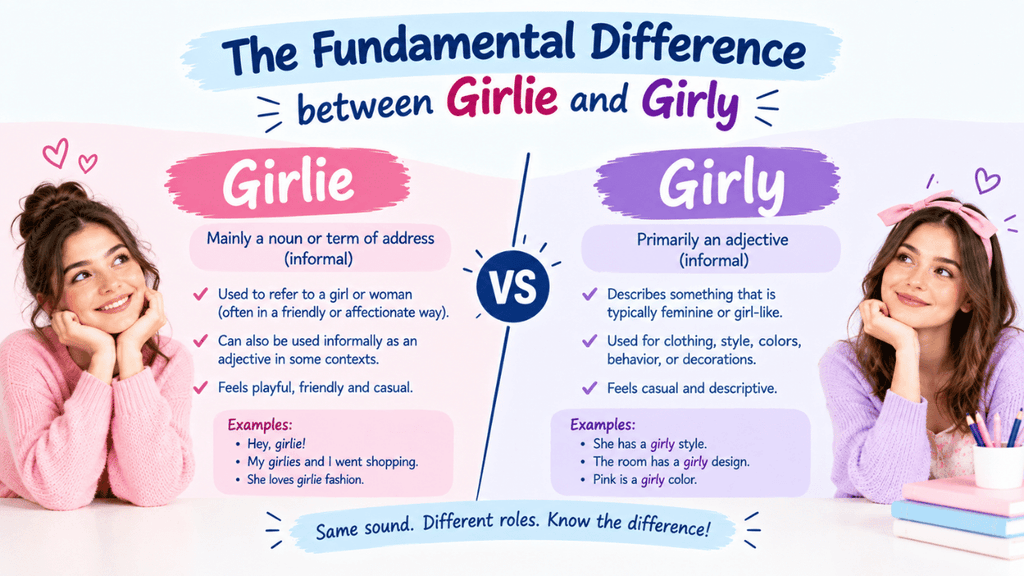
They are helpful in this regard because they tend to have consistent grammatical functions.
Girly is primarily an adjective. It refers to something usually considered a girl’s or a feminine trait.
For example:
- She has a very girly style.
- The room has a girly design.
- She bought a girly pink dress.
- The decorations are cute and girly.
On the other hand, girlie can be an adjective in informal English but is much more often used as a noun or term of address.
For example:
- She loves girlie fashion.
- Hey, girlie, how are you?
- The group of girlies went shopping.
The precise meaning of which can be very context-dependent.
Between girlie or girly, generally speaking, the simplest option for an adjective is just “girly”
Girlie or Girly: Comparison
| Feature | Girlie | Girly |
| Common use | Informal | Informal adjective |
| Can describe something feminine? | Yes | Yes |
| Can be used as a noun? | Yes | Generally no |
| Can be used as a form of address? | Yes | No |
| Tone | Playful, friendly, casual | Casual, descriptive |
| Example | Hey, girlie! | She has a girly style. |
| Best for formal writing | Usually avoid | More acceptable, depending on context |
This comparison helps to differentiate girlie or girly even better.
When Should You Use “Girly”?
If you are looking for an adjective that can make something seem more traditional feminine or girly, use “girly.”
For example:
- She bought a girly dress.
- I love girly accessories.
- Her bedroom has a girly aesthetic.
- That hairstyle looks very girly.
- She likes cute, girly designs.
In this case, girly is modifying a noun like dress, accessories, aesthetic, hair style or designs.
If you cannot decide whether to go with girlie or girly and just need an adjective, opt for the more obvious girly.
When Should You Use “Girlie”?
Use girly when speaking informally and conversational.
Used when you are talking to someone in an affectionate context.
- Hi, girlie!
- What’s up, girlie?
- Thanks, girlie!
It can also be used informally as a noun:
- The girlies are going out tonight.
- I’m meeting my girlies after work.
- My girlies always know how to cheer me up.
If you use “girly” in these examples, it is not the correct word to describe what has put into effect.
This is probably one of the most important distinctions when we’re talking about girlie or girly.
Is “Girly” a Proper Word?
Yes. “Girly” is an informal adjective in the English lexicon.
Usually used to describe some sort of feminine or girly.
For example:
- She has a very girly personality.
- I prefer a less girly color.
- Her room has a girly theme.
Despite being informal, girly is well-knwon and widely used in everyday English.
But in a more formal academic or professional paper, you probably want something more precise like “feminine” depending on what you’re trying to say.
Is “Girlie” a Proper Word?
Okay, well “girlie” is an English-language word too but has uses other than the clearly Biblical ones.
It acts informally as an adjective, noun or a direct address. It can convey different meanings or tones depending on the context.
For example:
Adjective:
- She likes girlie fashion.
Noun:
- The girlies are having a movie night.
Term of address:
- Hey, girlie!
Since “girlie” is strongly connected with informal communication, it may not fit well in more formal writing.
Girlie or Girly on Social Media
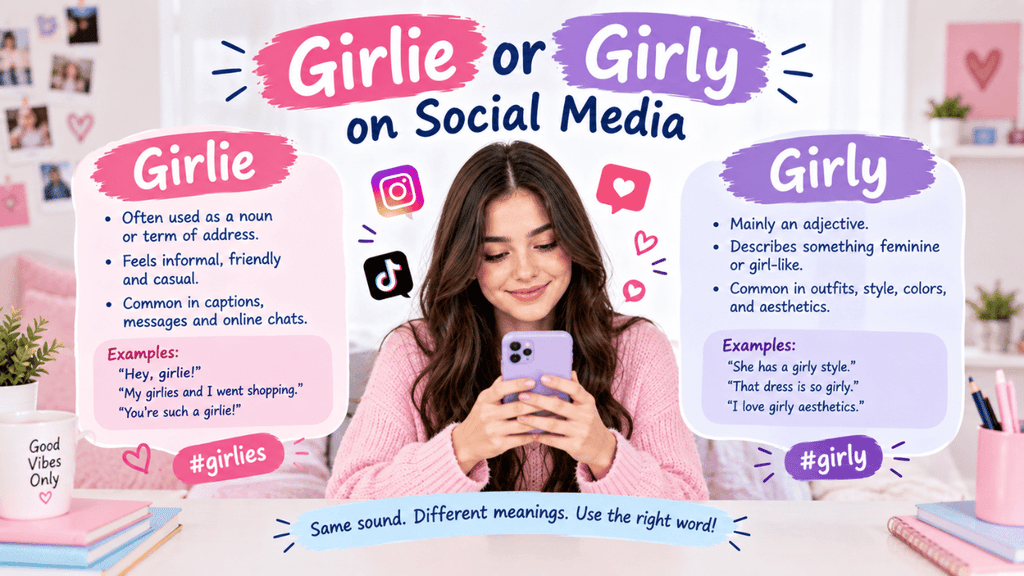
The division between girlie or girly has been made even more exciting by social media.
On the internet, we often refer to one another as “girlies”; it means no harm – or necessarily anything at all. You see it in comments, captions, text messages and videos.
Examples include:
- “Girlies, I have a story to tell!”
- “Hey girlie, you need to try this.”
- “Just a girlie enjoying her coffee.”
Phrases like “girlies” and “girlie pop” and similar tongue-in-cheek vernacular have also spread through online communities.
Meanwhile, the word “Girly” is often used with an aesthetic, style or activity:
- girly aesthetic
- girly outfit
- girly room
- girly makeup
- girly playlist
- girly nails
This is why there are plenty of instances on social media to show how girlie or girly can function differently.
Examples of “Girly” in Sentences
A few examples to clarify the usage
- She chose a girly pink dress.
- Her bedroom has a soft and girly aesthetic.
- I love her girly jewelry collection.
- The invitation has a cute and girly design.
- She wanted something feminine but not too girly.
- That handbag has a very girly appearance.
- They created a girly theme for the party.
- She enjoys traditionally girly hobbies.
- The colors make the room look bright and girly.
- Her outfit has a fun, girly style.
Those examples are indicative that “girly” is a more of an adjective.
Examples of “Girlie” in Sentences
And now for some examples of “girlie”:
- Hey, girlie, how have you been?
- My girlies and I are planning a trip.
- Thanks for helping me, girlie!
- The girlies are meeting for coffee.
- She loves a cute girlie aesthetic.
- Come on, girlie, let’s go.
- The girlies had a fun night together.
- I saw my old girlie friend yesterday.
- She’s having a girlie weekend with her friends.
- Girlies, you have to see this!
Observe that girlie can be a noun or address, but it also does an informal adjective duty.
Girlie or Girly Common Mistakes
One prevalent error is treating “girly” as a noun.
For example:
Incorrect or unusual:
“Hey, girly, how are you?”
Although someone might use this informally as a playful expression, “girlie” is more naturally used for this purpose.
Another example:
Natural:
“My girlies are coming over.”
Not natural:
“My girlys are coming over.”
When referring to the informal noun for multiple friends, it is usually spelled “girlies”
Another mistake is to assume that the two words are completely interchangeable. Though they use the same adjectives, it does not mean they have the same grammatical form.
Girlie or Girly for Fashion
Both words can be used when discussing fashion but typically girly is a more direct descriptor.
For example:
- She has a girly fashion style.
- I bought a girly pink sweater.
- Her outfit looks cute and girly.
“Girlie” can also appear in informal lifestyle or fashion contexts:
- She loves girlie fashion.
- We had a girlie shopping day.
The selection is really dependent on how you use it, Girlie when describing something, or as one would in a casual expression.
Girlie or Girly for Aesthetics
“Girly” is very much a common descriptor for an aesthetic.
You might see:
- girly aesthetic
- girly bedroom
- girly makeup
- girly fashion
- girly wallpaper
- girly nails
In casual online language, particularly social media captions and lifestyle content, “Girlie aesthetic” is also employed.
But in formal or literary writing, more commonly feminine aesthetic, even sometimes exquisitely boned.
Is “Girlie” a Nickname?
“Girlie” is an informal term of endearment or friendly form of address.
For example:
- “Good morning, girlie!”
- “You look amazing, girlie!”
- “Don’t worry, girlie. Everything will be fine.”
The tone can be loving, light-hearted but completely situational depending on the relationship of the individuals speaking.
As a result, “girlie” falls more often in casual conversation than formal speech.
Is “Girly” Positive or Negative?
Even the notion of “girly” is not inherently positive or negative. It has context-dependent meaning and inflection based on the intent of the speaker,
Someone might say:
- “I love this girly dress.”
In this place the term can communicate gratitude.
Another person may casually cloud a specific activity or style, fleshing out the word girly. Because of this, context matters.
Likewise, girlie can sound more like endearment in one talk and condescending in the next. Also, the speakers and the tone of the conversation can affect interpretation of the word.
How to Remember the Difference
A simple thing that can help you remember girlish or girly.
Consider girly as describing word,
For example:
- girly dress
- girly style
- girly room
- girly colors
Think of girlie as the friendly person word.
For example:
- Hey, girlie!
- My girlies
- Thanks, girlie!
It is a good rule of thumb to remember that “girlie” can also act as an adjective: this isn’t an absolute rule.
Girlie or Girly: Which Should You Use?
There is no one correct answer as it all depends on the sentence.
Use girly when referring to something that is feminine or otherwise considered a characteristic of girls.
Girlie is used while speaking casually to a person, female friends with an ironic tone or intentionally writing in a girlish speaking style.
For example:
Describing something:
“She has a girly bedroom.”
Addressing someone:
“Hey, girlie!”
Talking about friends:
“My girlies are coming over.”
The simplest way to decide if girlie or girly is appropriate is knowing the function of the word in a sentence.
Also Read: Bearly or Barely | Presentor vs Presenter | Comming or Coming
Conclusion
The mix-up amongst girlie or girly typically stems from the fact that these two words look and sound extremely similar. Still, their most common applications differ.
Girly is primarily an adjective used to describe something with a popular perception of being feminine or girlish in nature. Girlie can also function as an informal adjective but is especially commonly used in the sense of a noun or friendly form of address.
When describing a dress, room, style, color, or aesthetic, girly will often be the instinctive choice. Girly or girlies may be the more appropriate term if it is in casual conversation with a friend or about a few friends who are girls.
Upon understanding the context and what grammatical part you need to fulfill, it is much easier to pick which of girlie or girly to use.
FAQs About Girlie or Girly
1. Is “girly” or “girlie” correct?
Both of these are taught as correct words, yet they function differently. Whereas girly is used almost exclusively as an adjective, girlie can also function as an adjective, noun, and informal form of address.
2. Is “girlie” the same as “girly”?
When used as adjectives, they can have similar meanings but are not always interchangeable. Informal noun and address usages of “girlie” are also generally not part of the meaning of “girly.”
3. Is “girly” a slang word?
The informal adjective “girly” is not strictly slang. It is widely used in casual English and on the internet.
4. What is the plural of girlie?
In its use as an informal noun, the plural of girlie is usually girlies.
5. Can “girly” describe a person?
Yes. The term “girly” could be used to refer to a person’s appearance, behavior, style, or personality, but the tone of being complimentary or derogatory will depend on context.