
If you’ve ever had to stop halfway through a sentence to question whether to spell it eyeing or eying, you have run afoul of one of the more peculiar little spelling idiosyncrasies in English. For some of the most commonly confused word pairs, like a word on the tip of your tongue without you really knowing (but we will get into that later), one version is essentially wrong.
But both spellings are actually correct, although not used equally, and knowing the difference can help you write with more confidence. In this post, we go over all the particulars of eyeing or eying: which one does the dictionary like better, why there is confusion in the first place, and when each version shows up in actual writing.
The Short Answer
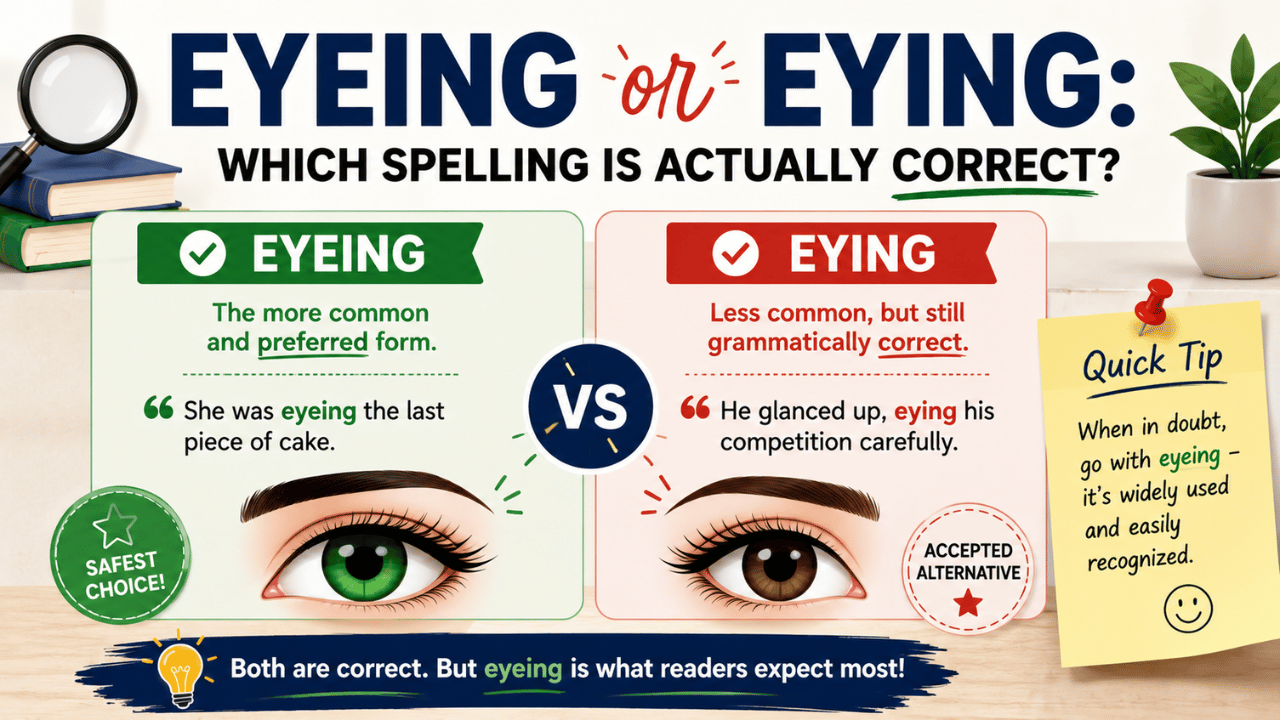
“Eyeing or eying, both spellings are grammatically correct, but eyeing is the far more popular and accepted form in modern English, particularly American English. It’s not really a mistake per se; “eying” is an accepted form according to most major dictionaries, but it appears considerably less often in published writing, style guides, and conversational use.
So if you are in a bind trying to decide between eyeing or eying and just want to take the safest option that is most likely going to be accepted by everyone, try “eyeing.” The longer version is the spelling readers are expected to see nowadays, and it avoids possible momentary confusion the shorter version can sometimes create.
What is The Reason for This Spelling Mistake?
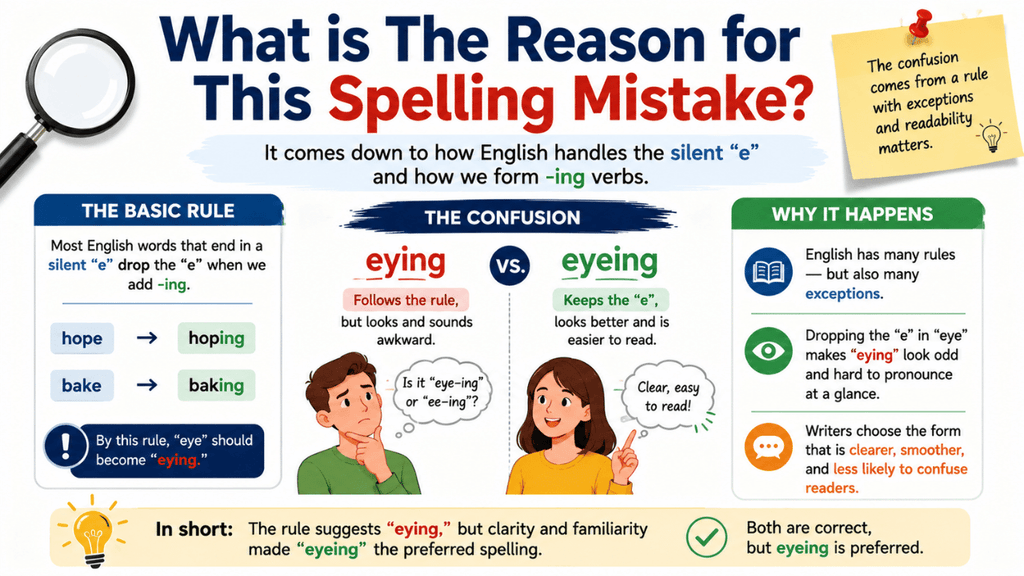
A common rule related to this is that most English words ending in the letter “-e” stay silent when we put them with the element “-ing.” For example, “hope” turns into “hoping,” and “bake” becomes “baking.” According to that same basic standard, the natural verb form of “eye” is “eying.” Well, that brings us to “eyeing,” which has the additional “e” on its end and is actually more prevalent and favored spelling.
1. The Strange Word a Standard Rule Makes
To take the rule for silent “e” dropping as literally as possible, “eye” yields “eying.” Although grammatically defensible, that variant is visually and phonetically clunky for many editors and writers; at a glance, the reader won’t know how to pronounce the first letter in this word. That’s a big part of why the eyeing or eying controversy continues to exist; the “correct by rule” spelling just doesn’t look quite right to many readers.
2. Retaining the Final “E” Improves Clarity
Similarly, English has a few cases where we do something similar to avoid ambiguity or an ugly-looking word. A popular analogy is to dye versus dying (that compare. Dropping the “e” in “dye” to form its “-ing” version gives you “dying,” which is already just a word for the act of death. So to avoid that confusion from “dye,” it’s actually “dyeing” instead, maintaining the e. Sure, “eye” isn’t nearly as risky a collision with its fellow sound-alikes (“dye”), but that same clarity-driven instinct has latched onto the word and helped “eyeing” win out as the preferred form over time.
3. Familiarity Reinforces the Preferred Spelling
When one variant becomes the more frequent in published writing, that familiarity snowballs. The same goes with eyeing or eying, which readers see so much more often in the phrase that “eye” looks instinctively correct even to someone who has never studied the grammar rule for that variant before. This is the very kind of feedback loop that governs the eyeing or eying debate in real-world usage, even if a strict grammatical rule doesn’t support it.
Also Read: Crier or Cryer | Seal vs Seel | Planed or Planned | Bearly or Barely
What Do Dictionaries Say?
Most major dictionaries, including Merriam-Webster as well as the Oxford English Dictionary, declare “eyeing” as the primary or dominant spelling of that verb, with “eying” qualified as an accepted alternative. That’s a constructively helpful note for anyone considering using eying/eyeing in their own writings: neither dictionary suggests “eyeing” is wrong per se, but both make clear that eyeing is the proper, standard usage.
| Dictionary | Primary Spelling | Variant Listed |
| Merriam-Webster | Eyeing | Eying |
| Oxford English Dictionary | Eyeing | Eying |
| Cambridge Dictionary | Eyeing | Eying |
| Collins Dictionary | Eyeing | Eying |
That major dictionaries all call the same article used for at least a meeting is a strong signal. If you’re uncertain about eyeing or eying, the version listed first in major dictionaries (as shown here) is probably a good bet most of the time.
Eyeing or Eying: American English vs British English
The region-wise usage is another dimension to the issue with eyeing or eying. Eyeing – in American English, this is by far the predominant form across books, newspapers, and general writing. In British English there is a similar bias that prefers “eyeing” over “eying,” although slightly more often in the UK than in the US, and it is still overall less frequent choice of spelling in both dialects.
Don’t worry if you write to a regional audience, style guide or publication, it’s probably best to see what they explicitly prefer, but “eyeing” will probably be the safer choice in virtually every case, even outside of American English.
When You Would See Eying
Although eyeing wins the contest between both words and eying is not extinct. You might come across it in:
- Older texts where spelling conventions varied somewhat from modern usage
- Casual writing, such as your everyday social media post or quick message where the writer probably just omitted that final e exactly as they would have written it with one despite not doing so in some other contexts simultaneously.
- Style guides, some publications have their own company spelling guidelines and lean towards the shorter side
- Regional or individual usage, where language use always contains some individual variation no matter what dictionary is used
None of these scenarios are untrue for “eying,” but they do explain why you may sometimes see it, even though “eyeing” is the overwhelming winner in formal and professional writing.
How to Remember Which One to Use
If you would like an easy way to solve the eyeing or eying dilemma in your own writing, use this memory device: remember that “eyeing” keeps both of your “eyes” clearly visible in its spelling, starting with an “e,” which is held on to before the “-ing.” If you remember that a watch is literally about changing your perceptions or watching something closely, then hopefully that visual cue of two “e”s taking the place of two eyes helps to cement in your memory the correct, more standard spelling.
Why This Distinction Matters in Everyday Writing
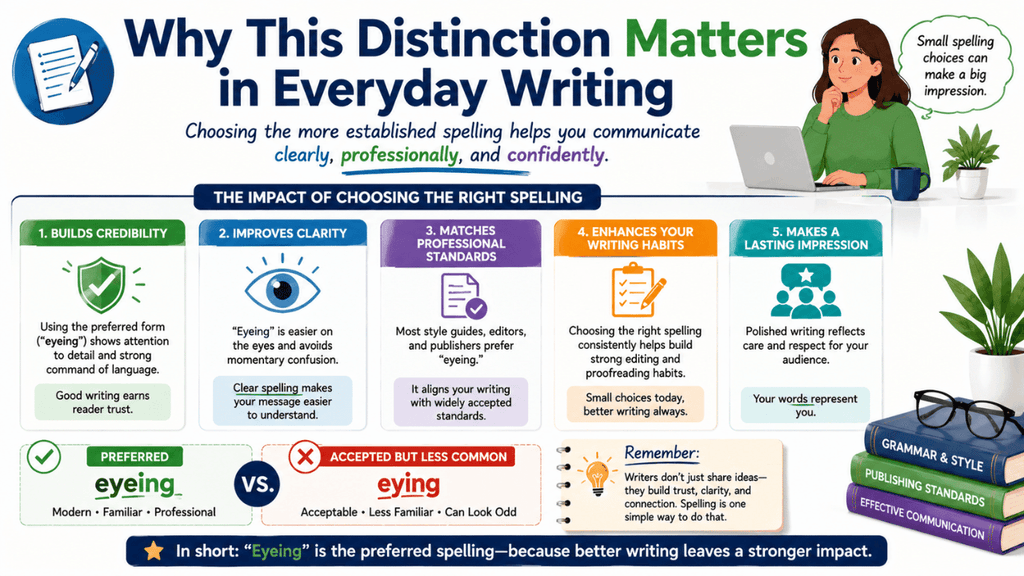
This seems like a minor detail, but it matters more than you think. Be it a professional email stating you are eyeing promotions, a news article on your company eyeing expansion into new markets, or just an intimate note to your friend over instant messaging that you are eyeing the last slice of pizza – some degree of consistency in spelling shows attention to detail. The reason for this is that there isn’t a single, universally enforced rule about which of eyeing or eying (with one i) should be used here, and to keep your writing looking polished and intentional rather than unsure, it’s best to go with the versions the dictionary prefers.
If you are a content creator, marketer, journalist, or anyone else who is writing for an audience of professionals, switching to using eye instead of eyes takes out any uncertainty about whether your writing fits what the majority of readers expect, and it also saves anyone encountering that sentence from having to pause and wonder if you made a typo.
Sample sentences with this information
Actually seeing the eyeing or eying issue that gets discussed play out in examples from normal sentences helps. A business story may say a company was “eyeing a merger with a competitor.” A sports headline might include a team “eyeing a spot in the playoffs.” A friend texting casually would say, like, “eyeing a new restaurant downtown. In each of these cases, the version “eyeing” is the one you may have seen in professionally edited writing, whereas technically speaking, “eying” would still be comprehensible, but it would look reasonably less professional in most readers’ eyes.
This trend is present nearly everywhere the term appears: A hawk keeping an eye on its prey; a shopper keeping an eye on a discount; or an investor keeping an eye on a stock that is rising. The consistency of “eyeing” across these diverse examples is a part of what makes it so dependable as a default whenever the eyeing or eying question arises in your own writing.
Also Read: Presentor vs Presenter | Pacient or Patient | Comming or Coming
Conclusion
The practical answer, though not a grammatically enforced one, is straightforward – both “eyeing” and “eying” are found in dictionaries and are technically legitimate spellings when it comes down to it, but eyeing (spelled with an e) is the standard dictionary-preferred and overwhelmingly widely accepted spelling of the word in American English and British English. Unless you have a style guide that says otherwise, “eyeing” is the safest and most widely recognizable word for eye-obsessed writing, formal or informal. So the next time you find yourself typing this word and debating whether to use “eyeing or eying” – go for the version that still has both ” e ” in it, and move on.
FAQs About Eyeing or Eying
1. Is “eying” a real word?
Yes. Eyeing is an acceptable variant, but eyeing is more common and generally the preferred form.
2. What is most people write “eyeing” instead of “eying”?
This longer form improves readability and makes the word easier to recognize.
3. Is “eyeing” even correct in US or British English?
Yes. “Eyeing” is the preferred spelling in either variety of English (seen without a double “e”).
4. What’s an easy way to remember the correct spelling?
Notice that in the word “eyeing,” there are two e’s, so think of two eyes looking at something.
5. Is eyeing or eying correct in formal writing?
“Eyeing” is, generally, the safer and more accepted formal writing choice.