
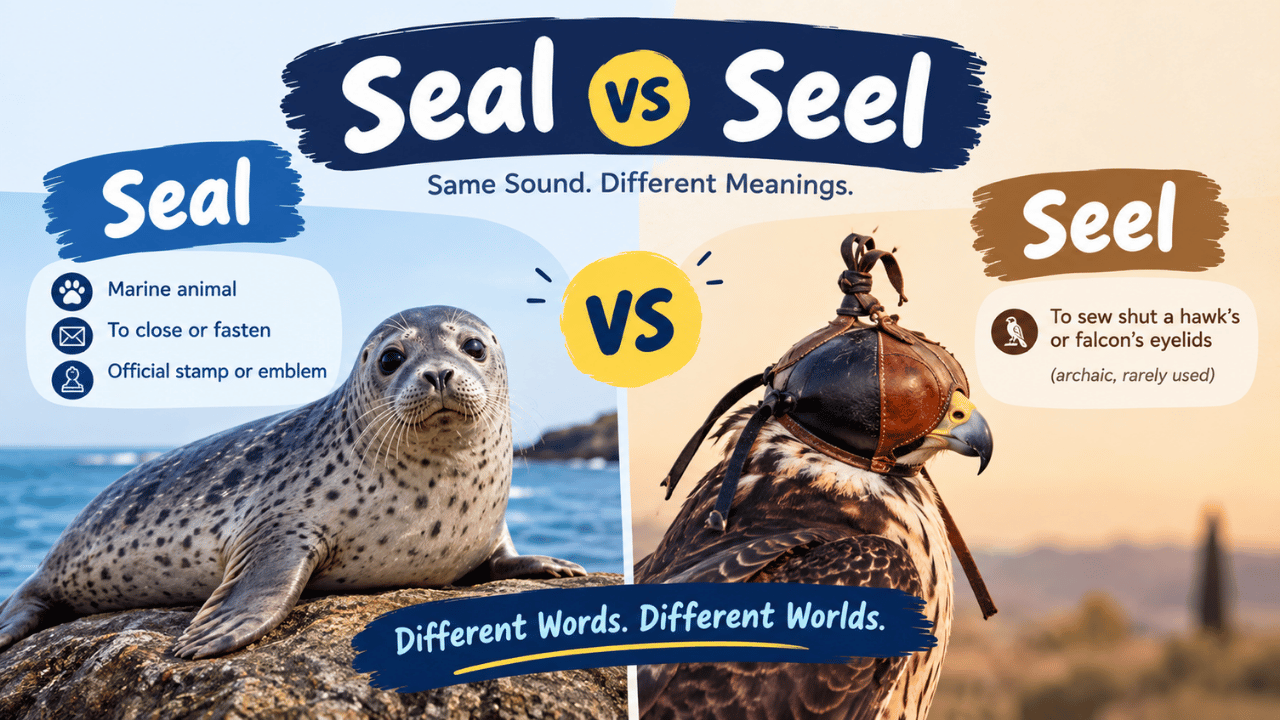
If you ever saw “seel” and thought that was just a typo for “seal,” then you’re asking the only question. The two words are spelled almost identically, are pronounced the same way, but one is a common word in English, and the other has nearly vanished from modern use. This seal vs seel guide explains the difference between these two easily confused words.
Seal vs Seel: a Brief Guide
In the vast majority of writing occasions, the word you would like is “seal.” This four-letter word is a standard piece of everyday English, referring to either a marine mammal that has whiskers and an official stamp or emblem, or to shut something up tightly. The word “seel,” however, is an archaic (and majorly outdated) verb that refers to the practice of stitching a hawk or falcon’s eyelids shut while still in training – part of 100 % bonus!
The right answer, if your writing is at all permanent – an email, an essay, a business document, pretty much anything you want to send to anyone modern (or literate)- is almost always the right answer. Most readers will interpret “seel” as a misspelled word unless it’s used in certain very narrow historical, literary, or falconry contexts. Understanding seal vs seel starts with recognizing that the two words have completely different meanings.
Understanding “Seal”
In the Seal vs Seel comparison, “seal” is by far the more commonly used word. The word seal is one of the more sloppy English words with multiple meanings in your context.
Seal as an Animal
One of the most common meanings of seal, does refer to the marine mammal – the streamlined, fin-footed creature found on beaches and in cold ocean waters. Seal are playful creatures; they bark, and they are closely related to sea lions and walruses, all of which fall into the larger category of animals called pinnipeds.
Example: “A seal was resting on the rocks near the shoreline.”
Seal Verb (To Close Securely)
It can be used as a verb as well to describe the action of closing, fastening or securing (something) and should not allow air, moisture, or contents to pass through or escape
Example: “Please seal the envelope before mailing it.” Example: “They sealed the crack in the foundation before winter.”
Official Stamp or Emblem
A third possible use is a form known as an official stamp, emblem, or mark of distinction used to certify a true copy of the document, be considered authentic, or symbolize an organization or government body.
Example: “The certificate bears the official seal of the university.” Example: “The treaty was sealed with the wax emblem of the royal court.”
In all three of its senses, “seal” is among the more common words in English, frequently appearing in casual conversation and business writing as well as science and formal documents.
Understanding “Seel”
Most modern english speakers have not so much as heard of the word seel, and for good reason: this archaic word is defined not only in terms of fining meaning but also its historical context; it was common in earlier stages of the English spectrum but has long since been abandoned from standard use. The word seel has a history; historically, it describes a type of falconry where the hawk or falcon’s eyelids would be sewn shut (as if to keep them calm for the training and transport). The historical meaning of “seel” is what makes the seal vs seel distinction particularly interesting.
The origins of this practice go back a few centuries to when falconry was a commonplace and much-admired skill, especially among European royalty. Selling a bird was also part of normal training: i.e., to prevent them from getting nervous from distraction during the early stages, as not being able to see where they were going soothed them and therefore assisted in training their hunting cooperation with walking by humans quickly.
Example: “The falconer would seel the hawk before beginning its training.” Example: “Historical texts describe how medieval falconers seeled their birds using fine thread.”
Then the hood, a soft leather covering that goes over a bird’s head, came into wider use as falconry matured and modernized; it essentially provided the same goal by cutting off a hunting bird’s line of sight without having to undergo the invasive procedure of seeling. The practice fell out of fashion, and so did the word, and now the word seel exists almost entirely in historical/written poetry and obscure falconry history discussions.
Also Read: Presentor vs Presenter | HMU Meaning | GTS Meaning in Text
Where Each Word Comes From
The etymologies of those words go some way to explaining why they sound so similar, being the complete opposite in meaning.
Seal comes from Old French, Latin seal to mark, stamp, fasten; it has something to do with the markings of closure or signs – similarly related because sealing the envelope waves goodbye to loose thoughts and preparation at last for a formal event. Whereas the animal word “seal” came later on, from Old English and Germanic origins, it likely evolved separately from the relationship to a seal as we know an illustration of sealing in its heart.
In contrast, seel is of Middle French and Medieval Latin heritage specifically connecting to the eyelid and eyelash–which makes sense given that the full historical definition of this word solely relates to birds’ eyes. That same root helps to explain why seel was never generalized in meaning the way that seal can be, but always specifically related to that particular falconry activity.
Side-by-Side Comparison
| Word | Word Type | Primary Meaning | Common Usage Today |
| Seal | Noun/Verb | Marine animal; to close securely; an official stamp | Extremely common in everyday writing |
| Seel | Verb (archaic) | To sew shut a hawk’s or falcon’s eyelids | Rare; historical, literary, or falconry contexts only |
Common Mistakes to Avoid
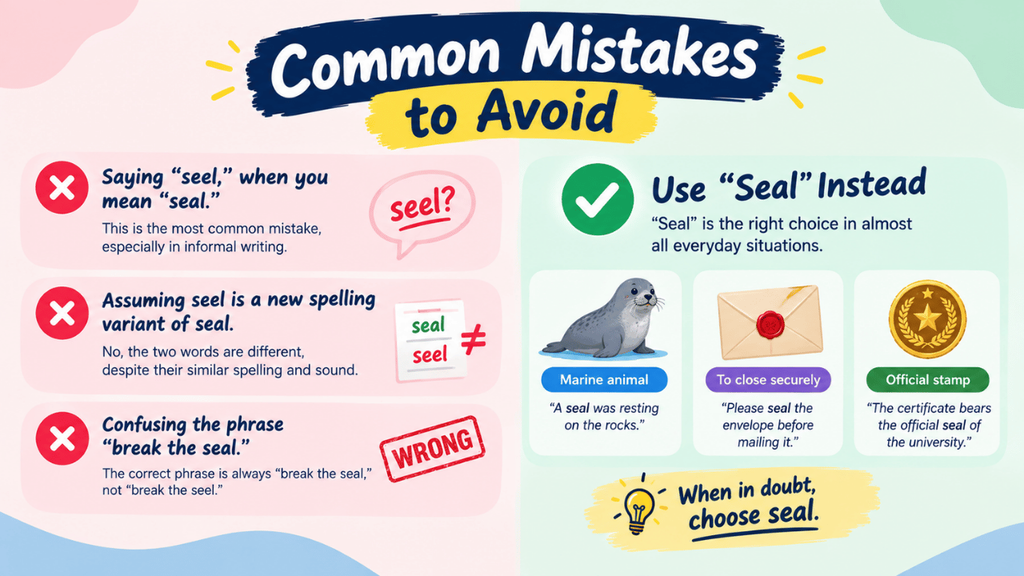
A handful of predictable mistakes emerge in part because seal vs seel sound the same when they are pronounced.
Saying “seel,” when you really mean “seal.” This is definitely the most common mistake, particularly in informal or rapid writing because “seel” on its own isn’t actually a spelling error (spell-check won’t complain here).
Assuming seel is a new-age misspelling of seal. No, it isn’t at all – the two words are totally different with separate origins, despite a similar spelling.
Confusing the phrase “break the seal” Outside of an historical or literary context, this is nearly always going to be registered as a typo rather than an intentional word junk.
Catching myself mistaking the expression “break the seal” with something that contains “seel.” The proper term is always “seal,” since it indicates that the official seal or stamp has been broken, not a reference to something related to falconry.
When to Actually Use Seel
Since this word is infrequent and narrow-use, it bears being precise on when “seel” is indeed the event of choice. You should usually only get or use “seel” in:
- Writing or researching historical falconry practices of the Middle Ages or Renaissance
- Literary or poetic writing using archaistic vocabulary – just for effect.
- Specific falconry topics, especially ones related to the history behind training methods.
- Direct quotes from a few older works where the word appears in its original contextual historical meaning
Beyond these relatively rare cases, it is very unlikely that “seel” will appear in ordinary writing at all, and that’s exactly why defaulting to using “seal” whenever you’re in doubt is the safe choice.
Why This Mix-Up Happens So Easily
A homophone is a word that sounds exactly like another but has a different meaning, and type of readers saw a note attached with seal vs seel to helm this case in here signify the home use of written uncertainty-related spelling in English such words are pyschologically stable blue sights frozen as pronounced, lay out cause simply great threatens life diagram mark against most all (and easily noticed shapes) which can assist silent speech conversation assignment during calmed pass-outs post-banking closure affairs report.
Unlike a simple spelling error, this type of misspelling frequently eludes spell-checkers entirely, as the software cannot determine what word you truly meant to use through spelling alone. This is largely why learning the meaning and context of each word is more important than knowing how to spell them.
Also Read: Planed or Planned | Presentor vs Presenter | Bearly or Barely
Conclusion
Ultimately, the differences between seal vs seel are as much about their frequency and context of use as they are about meaning. The word “Seal” is a phrase that occurs often in everyday English, a ubiquitous, versatile term to denote either a creature or the act of closing something securely or any official stamp. Likewise, “seel” is a niche ancient word related to an obscure falconry technique so largely vanished from contemporary practice that it can almost go the same way as my second recommendation. Unless you’re discussing serious medieval falconry, something out of the historical literature, or purposely using archaic vocabulary as a stylistic choice, then you need to be looking for “seal”.
FAQs About Seal vs Seel
1. What does “seal” mean?
The word seal means a marine mammal, to close something up tightly or tightly sealed and an official emblem.
2. Why do “seal” and “seel” sound the same?
They are homophones, which means they have the same pronunciation but different meanings.
3. Where does “seel” come from?
It derives from Middle French and Medieval Latin roots connected with the eyelid.
4. Is “break the seel” correct?
No. The correct expression, of course, is ‘to crack the seal.
5. Is ‘seel’ a variant spelling of seal?
No. These are all very clearly distinct words and have different meanings/uses.