
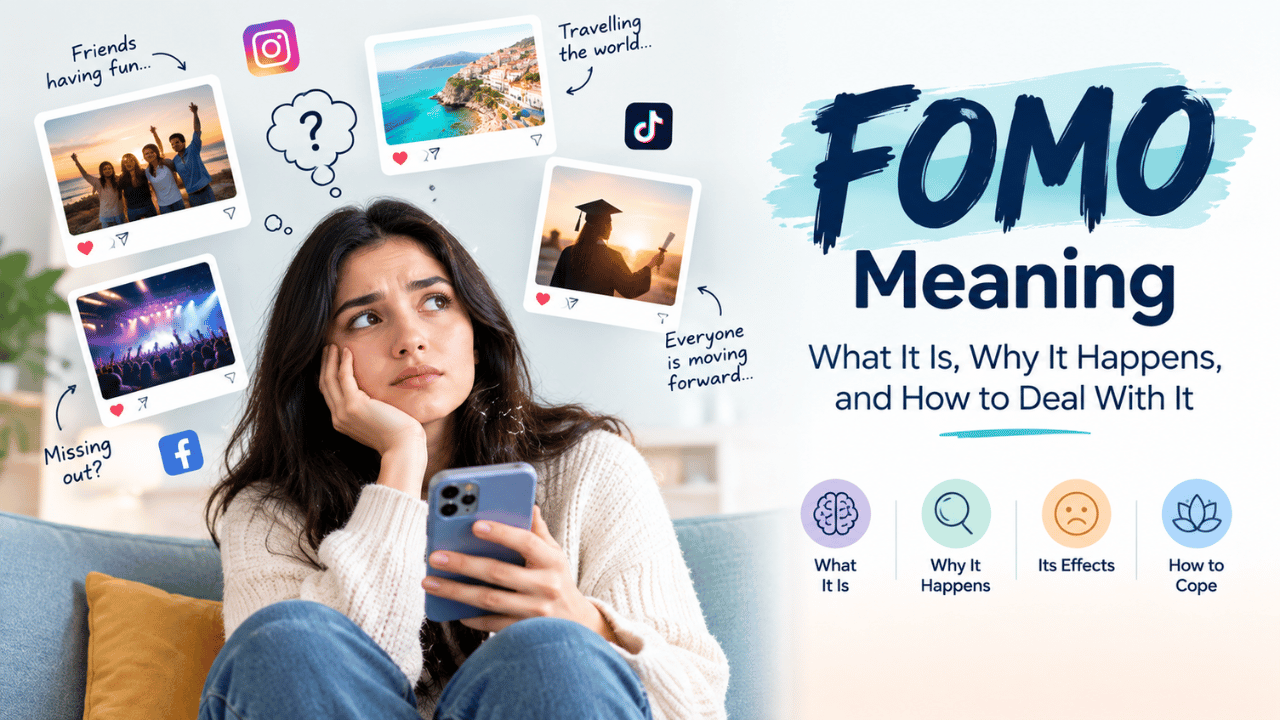
If you’ve ever been flicking through social media and felt a little twinge of anxiety watching your friends have fun at a party you weren’t invited to, or put off from switching off your phone for fear of missing out on something important, then you’ve experienced exactly what this term is describing. With phones in our pockets reminding us of what everyone else is doing (and experiencing) at that very same moment, it makes a lot of sense to understand the FOMO meaning.
In this guide, you will discover exactly what FOMO is, where it comes from, how psychologically powerful it is, and most importantly, ways to combat it so that you don’t end up allowing something to quietly run your decisions or your mood.
The Quick Answer
FOMO stands for “Fear Of Missing Out”. It is the nervous, uneasy sensation that you feel when you believe other people are enjoying rewarding experiences, having fun, or taking advantage of possibilities that do not include yourself. This has less to do with the actual event, and more with the worry that everyone else was getting so absolutely right you’re missing out on something meaningful.
Despite the somewhat modern ring of the acronym, close to social media and constant online connectivity, the feeling it embodies is an age-old human phenomenon. When you really think about it, FOMO meaning is simply a modern term for a feeling that mankind has probably felt as long as there have been social groups. FOMO Meaning is very much related to the feeling that other people are having a valuable experience while you are missing out.
Where Does the Term “FOMO” Come From?
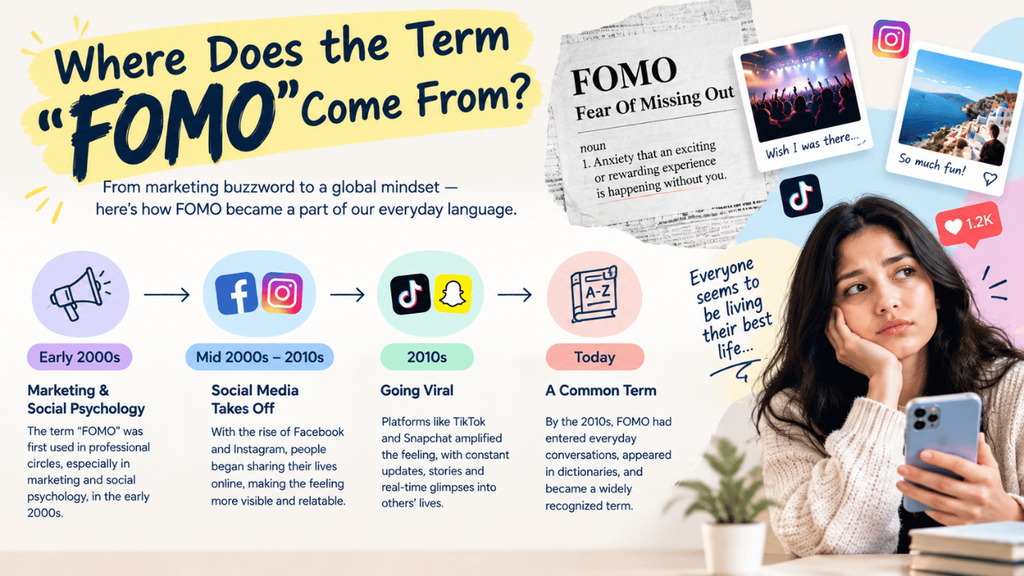
That very acronym “FOMO” came (in more professional language, this was slang) into being in the early 2000s, specifically in marketing and social psychology circles – before that, the expression became mainstream with the arrival of platforms like Facebook & Instagram, to later burst through with TikTok and Snapchat. Social media is awash with filtered snapshots of lives, with a perpetual feed of your friends travelling the world, going to festivals and parties, gaining promotions.
Academics and writers moved towards “FOMO” to fill a gap in shorthand for this particular sort of anxiety: a term that took off so fast, in part, because it described something that nearly all people have been feeling at some point or another but were not necessarily putting into words. It wasn’t until the 2010 s that the word settled comfortably into everyday vernacular, showing up in dictionary pages, casual conversations, and thousands of articles investigating its psychological origins. The use of FOMO Meaning started to become more common in everyday conversations with the rise of social media, particularly when people are talking about online trends and social events.
Also Read: FYP Meaning | GTS Meaning in Text | MYF Meaning in Slang
What Makes FOMO So Powerful?
Knowing what FOMO meaning is on the surface level, and even grasping why it feels so emotionally charged, are all well and good. There are multiple psychological and social determinants that make this feeling so persistent and at times, crashingly uncomfortable.
We are wired for social belonging. Being in a group – even today, from an evolutionary perspective – meant safety, resources, and survival. It was a big deal to be excluded or left out. Although life in today’s world does not resemble our ancestral environment whatsoever, that old wiring to be included in social groups hasn’t fallen away completely – it’s largely part of the reason why exclusion from a group photo can actually make you feel quite emotional. One reason the FOMO meaning is discussed so often today is the constant stream of updates people receive through social media platforms.
Modern and globalized society allow for social media to serve as magnification devices of the illumination into another individuals life. Before constant connectivity online, you simply wouldn’t have heard about most of the things you weren’t attending. Today, notifications, stories and posts practically ensure that there is no way for you to miss what you would have otherwise missed, sometimes in near real-time and with meticulous detail. Recognizing the FOMO meaning also entails recognizing how comparison, social pressure and the desire to fit in predictably affect how people approach opportunities.
FOMO Under Different Circumstances
You’re not just experienced with FOMO when there is a party or social event going on. The bigger picture of FOMO meaning, however, you soon begin to see it everywhere around you.
Social gatherings. Being reminded you were never invited to an event
Travel and experiences. It is our friends posting their vacation pics and making us feel like we’re falling behind in life.
Career and opportunities. The news of a colleague being promoted, or a friend starting a new job, or someone else’s business is doing well and you feel like you are lagging career wise.
Shopping and consumer behavior. You’re under the impression that if you don’t buy it now during a flash sale or limited-edition drop, you’ll find yourself regretting not purchasing it later on.
Trends and pop culture. The pressure to watch a specific show, try a product, or take part in a viral challenge because it is trending and seems like the thing everyone else is doing.
Relationships and social circles. Fretting that friendships are changing or that people have deliberately not invited you to hang out with a group without having actual evidence that this is the case.
The first step to better dealing with FOMO is often recognizing these patterns, as it can be easier to manage a feeling when you know when and why it surfaces. The FOMO meaning can apply to many everyday situations, from missing social events to worrying about career opportunities or popular trends.
The Difference Between FOMO and Healthy Motivation
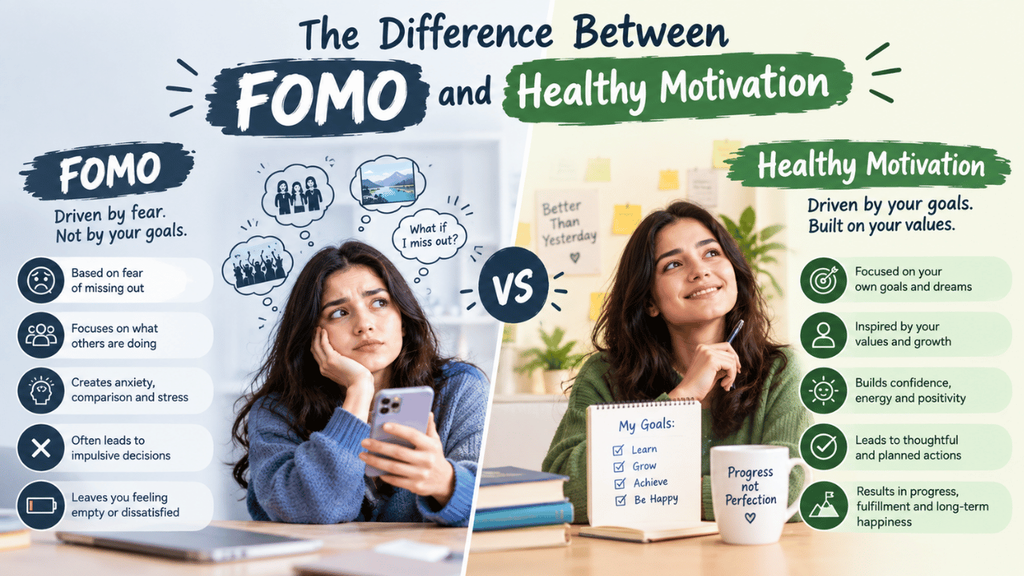
There is a real difference between authentic enthusiasm for an opportunity vs the anxious fear of missing out if your are doing it because you feel that pressure of comparison.
On the other hand, healthy motivation is usually derived from curiosity or personal aspirations: being drawn to a location you want to travel to, learning to do something new because it interests you genuinely. While FOMO, on the other hand, is often less about a genuine interest in the experience and more about anxiety over being excluded. FOMO drives someone to drag ass to something they don’t want to go, solely because the thought of not getting this experience is worse than going to something they couldn’t care less about.
Recognizing the source of these two emotions can empower you to act from what is more true to your heart, and not simply from fear of missing out.
How FOMO Affects Mental Wellbeing
Having the odd twinge of FOMO can come with the territory as we all know by now from living in this hyper-connected digital world, but having chronic or severe FOMO can take a serious toll over time. Some common effects include:
- High levels of anxiety and stress, especially those associated with social network interaction and continuous comparison.
- Decreased life satisfaction, because it’s hard to assess your everyday existence against someone else’s best bits.
- Impulse buys, or scheduling a bunch of things with friends out of FOMO instead of actually wanting to hang out.
- Difficulty being present, since a mind preoccupied with what’s happening elsewhere struggles to fully engage with what’s happening right now.
Seeing these patterns does not mean there is something wrong with you, but just that FOMO has become an automatic response worthy of your awareness.
Practical Ways to Manage FOMO
The positive is that FOMO, as much as it is an unpleasant emotion, becomes incredibly manageable once you can identify its source. These are a few useful techniques to try with your own vision.
Limit social media consumption intentionally. You don’t have to give up social media altogether, but limiting how often or for how long you scroll can severely lower your exposure to constant comparison triggers.
Learn to be grateful for everything you have already. If you keep recognising all the blessings in your own life you counterbalance yourself away from constantly pulling into what others have or are doing.
Instead of reacting to it, get curious about the feeling. If you feel FOMO creeping in, press pause and take a moment to ask yourself whether or not you really want to do whatever it is you’re seeing, if the actual discomfort stems from the exclusion rather than a real desire.
Concentrate on your objectives and ideals. It basically shifts the focus back to what you have going on and away from the other people’s highlight reel so comparison exercise is far less emotionally charged.
Keep in mind that social media is a curated reality. No one posts the boring, mundane or challenging times. With this in mind, you can make quality of life with comparison-based anxiety more manageable.
Practice being present. There are simple mindfulness techniques, such as being present in a conversation or activity and not looking at your phone, that can reduce the urge to constantly wonder what else is happening outside of this space.
These techniques do not rely on eradicating FOMO, as some of it is simply a side effect of being a social animal in the connected world. What you want is to lower its intensity and frequency enough that it lofts itself off from meaningfully affecting your happiness or decision-making at all.
Also Read: HMU Meaning | My Shayla Meaning | Clingy Meaning
Conclusion
To really understand FOMO meaning, it takes more than recognizing the acronym itself. It’s about acknowledging a smart human impulse, it’s well within us to want social acceptance but now technology and always-on connectivity have taken this individual need to the extreme. Whether it manifests as anxiety about missing out on a party, a sense of concern that you should be buying an item during the sale of the decade or simply an ongoing feeling that everyone else’s life is way more spectacular than your own, FOMO is actually normal rather than something to loathe until you low-key hate yourself.
It is possible to have your mind and emotions in the right place if you learn to notice when it’s happening, challenge whether the underlying desire is real or merely driven from some kind of social comparison, and then drawing boundaries around social media or harnessing that life-integrating FOMO created by always being connected.
FAQs About FOMO Meaning
1. Is FOMO a psychological phenomenon?
Yes. An idea called the fear of missing out relates to social comparison and our need to fit in.
2. Can FOMO affect decision-making?
Yes. This can lead to impulsive spending, over-committing and basing your choices on fear of missing out.
3. What sets FOMO apart from real excitement?
Personal knowledge represents genuine excitement, while FOMO derives from a fear of missing out or being behind the curve.
4. Is occasional FOMO unhealthy?
No. A little bit of FOMO every now and then is perfectly reasonable but when your FOMO becomes frequent or especially intense it might begin to take a toll on your quality of life.
5. How can FOMO be reduced?
Minimize time on social media and be grateful for your own lived experiences.