
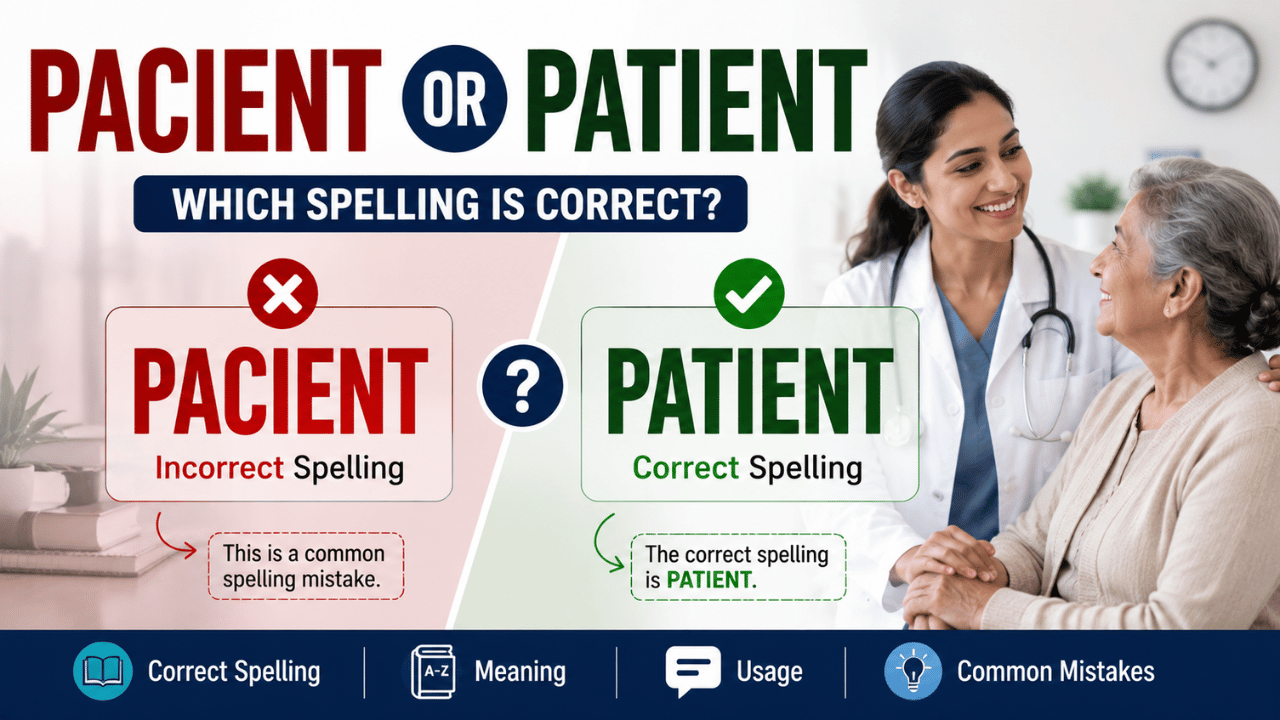
There are hardly any spelling mix-ups as consistent as the confusion between pacient or patient. And this error in particular, it shows up time and time again, whether a writer is composing a quick note, filling out medical paperwork, or typing a message describing his or her own personality. In this article, we will put that question to rest for good, explain why this common mistake occurs over and over again with perfect clarity, and give you a few simple tricks to ensure that it is never made again.
The Correct Answer
Well, first let us just take the most basic part. And when to use pacient or patient, the only proper spelling is always “patient,” spelt P-A-T-I-E-N-T. It is the only one accepted as a formal word in English, and it has two fairly close but different meanings. Like, it can refer to “one who receives medical care,” as in “the doctor examined the patient”; or it can imply a personal quality of being able to wait calmly without becoming annoyed, as in “she was very patient while waiting in line.”
The version applied as “pacient” through no means exists in English, and could never be found in a common body of writing dictionary. So regardless of which meaning you infer, whether it is visiting someone at the hospital or referring to a calm and peaceful temperament in a person, it is always “patient”.
The Reason Behind this Confusion
The reason many people confuse pacient or patient lies in a combination of language and spelling habits, as I explain below. In many other languages, like Spanish, Portuguese, French and Italian, the equivalent word uses spelling with a letter “c” not a letter “t”, thus in Spanish and Portuguese it is “paciente”, while in Italian it is written as paziente. For bilingual speakers or English learners whose primary language uses one of these spellings, it is simply understandable that they have carried the same “c” spelling into English.
Apart from the influence of the languages, the English word “patient” itself can cause confusion. In the word patient, the “ti” combination offers a “sh” sound, which to someone unfamiliar with this unique spelling pattern does not immediately lead to the letter “t,” so it’s an easy pitfall to fall into when opting for what is more phonically intuitive, like the use of c.
Examining the British English Spelling of ‘Patient’
To make some sense, or even Zainab B. Berger sense, of why pacient or patient typically takes the “t” version, it helps to look at where that pattern originates in English more generally From the Latin for “suffering” or “enduring,” patientem, the English word patient is also a largely intact inheritance due to Old French modifying of it. A new learner or a fast typist might expect the “ti” combination, which sounds like “sh” in patient, nation, and station, to be in English enough; it is not at all intuitive.
Realizing that patient falls into this large, easily identifiable type of English words makes it much less difficult to remember its correct spelling because it’s not a true solitary exception that just kind of hangs there by itself; it goes together as part of a predictable, if somewhat tricky, spelling form.
Comparing Patient to Similar Words
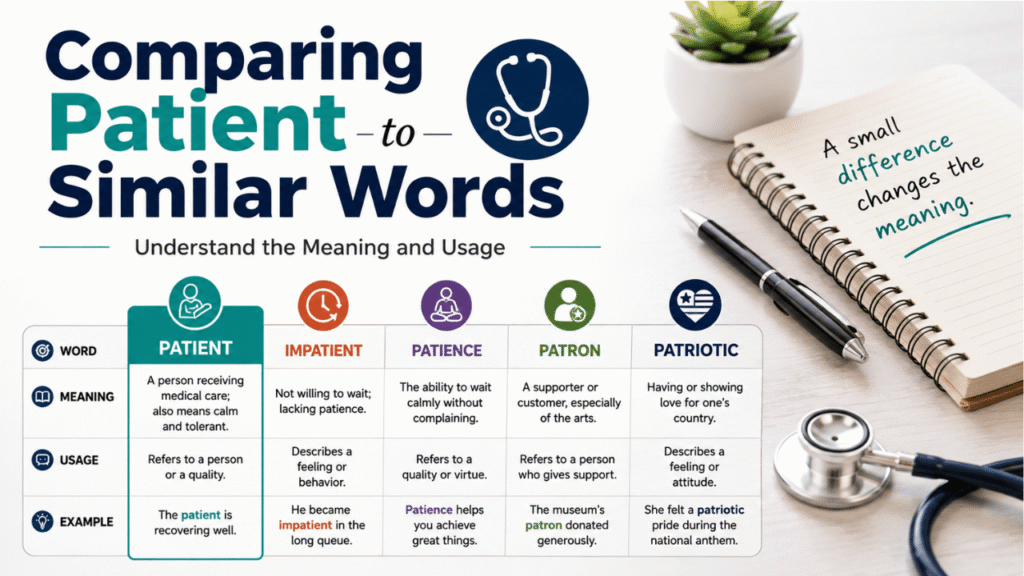
If there are any doubts about whether the above sounds right, practising putting “patient” in place with other English words that follow this same “ti” pattern can help cement its correct spelling, even if it doesn’t sound how a casual reader might expect.
| Word | Spelling Pattern | Sound Produced |
| Patient | -tient | “shent” sound |
| Nation | -tion | “shun” sound |
| Station | -tion | “shun” sound |
| Ancient | -cient | “shent” sound |
Interestingly, this table also shows part of the reason why the pacient or patient confusion goes on. The word “ancient” is spelled with a c, making it an almost identical sound to the way we pronounce “patient,” which is spelled with a t. All of this sounds just alike even though they are more different than they are similar, so if someone mixes up the ancient spelling pattern with the patient spelling pattern, I could understand how they arrived at that conclusion.
Also Read: My Shayla Meaning | HMU Meaning | Clingy Meaning
The Reason “Ancient” Adds an Extra Layer of Confusion
That link to “ancient” is worth delving into a little deeper, because it’s probably one of the most significant underlying reasons for the pacient or patient mix-up. The two words end with a pronunciation that sounds almost identical when heard: “ancient” is indeed spelled with a c, and yet for patient it’s, no universal rule that applies to the spelling of every English word containing this sound in that position, which means both spellings need to be memorized separately instead of just phonetically.
Such inconsistency is a famous feature of English spelling in general: pairs (sometimes triplets) of words that can sound almost the same but take different, non-interchangeable spellings.
Common Situations Where This Mistake Appears
The Patient mix-up tends to occur more often in certain, expected settings. A few common examples include:
- Medical Forms and Healthcare Writing (The pacient has been called to their appointment)
- Descriptions of a personality or disposition (“She is a very pacient person”)
- On home assignment and paperwork – especially among the English language students
- Brief, casual messages typed without proofreading
Since this word specifically refers to brainstorming in medical or health care contexts, it becomes ever more critical to spell accurately in formal work spaces such as clinics and hospitals, actual clinical documentation, because the accuracy and consistency of spelling directly reflect professionalism and attention to quality detail.
Easiest ways to remember correct spelling
If you often confuse pacient with patient, here are some aids to ensure that the right version sticks in your mind once and for all.
- Remember “Ti” for “Time.” Explain that patience with a little “the ti word is like time” & because being patient often means waiting, so take note of the “ti” in patient through the concept of waiting through time – takes notice (Reinforces and rabbit holes into the right letter pattern’
- Compare it with station and nation. These very common English words all match the same “ti” pattern as well, showing that “patient” is NOT an odd exception.
- Handwrite it multiple times. Saying the correct spelling of a word is usually more effective than simply reading it.
- Separate it from “ancient” consciously. Reinforcing the fact that “antient” and “patience” sound similar but take different spelling rules can ensure your mind does not default to a pattern.
- As soon as you learn a new word, use it in a sentence. Using the word in context will lock it into long-term memory far better than memorizing it.
How Spelling Things Make A Difference Here In Our Healthcare
More than just proper writing, the pacient or patient distinction is especially vital within health and medical related fields. These systems, which all hospitals, clinics, insurance companies and medical record systems are dependent on as they require accurate data entry of names and terms to produce consistent results; a wrong name, even one such as this (the state bird of South Carolina) can cause occasional confusion in administrative systems or official records or professional correspondence.
For healthcare workers, students in medical or nursing programs, and anyone working in health-adjacent administrative roles, grasping this spelling distinction is more than just an esoteric exercise in general literacy – it becomes an everyday professional task reflected incessantly across patient records and correspondence.
Does Autocorrect Catch This Mistake?
Yes, and usually it will change “pacient” into “patient” as soon as you type it because it’s not a recognized English word – that’s how the modern autocorrect action goes in most modern-day word processors, smartphones and web browsers. Without the aid of built-in spell-check support, earlier decades had it hard for native English speakers to cope with this mix-up of pacient or patient on a daily basis; hence, the approach is easier now.
Of course, autocorrect is not present in every writing environment, especially specialized medical software, handwritten forms, or messaging apps that offer limited spell-check capabilities. Being aware of the correct spelling yourself instead of relying 100% on auto-correct is particularly important in the professional and academic world where a misspelling stands out so much more.
Also Read: Comming or Coming | FYP Meaning | GTS Meaning in Text
Conclusion
When it comes to pacient or patient, the answer is simple: no matter if you are talking about someone in need of medical assistance or a person with a yoga-like demeanor, “patient,” spelled with a “-t” is always correct. What really adds to this confusion are the “ei” words in other languages that speak their sounds more like a long ‘e’ over our English ‘ti.’
As well, English also has its own consistent/ inconsistent “ti” vs. ci spelling (as easily seen by comparing the word above with patient against the similarly pronounced yet mistakenly abbreviated word ancient!) After some practice and a few mnemonics, spelling the right choice is automatic, so rather than questioning your choice every time you write it.
FAQs About Pacient or Patient
1. Why is “patient” Often Misspelt As “pacient?”
It could be first language interference: it might have to do with how certain English spelling patterns get confused.
2. Is there more than one meaning to the word “patient”?
Yes. It could refer to someone being treated medically, or it could be a quiet, tolerant individual.
3. Why do you write “ancient” differently than “patient”?
Because spellings in English can vary, these need to be learned generally individually.
4. Will autocorrect fix “pacient”?
Usually, yes. The modern device most of the time suggests or makes the correction.
5. Why is correct spelling important in healthcare?
Correct spelling is necessary to ensure professionalism and avoid confusion in medical records and communication.
1 thought on “Pacient or Patient: Which Spelling Is Actually Correct?”