
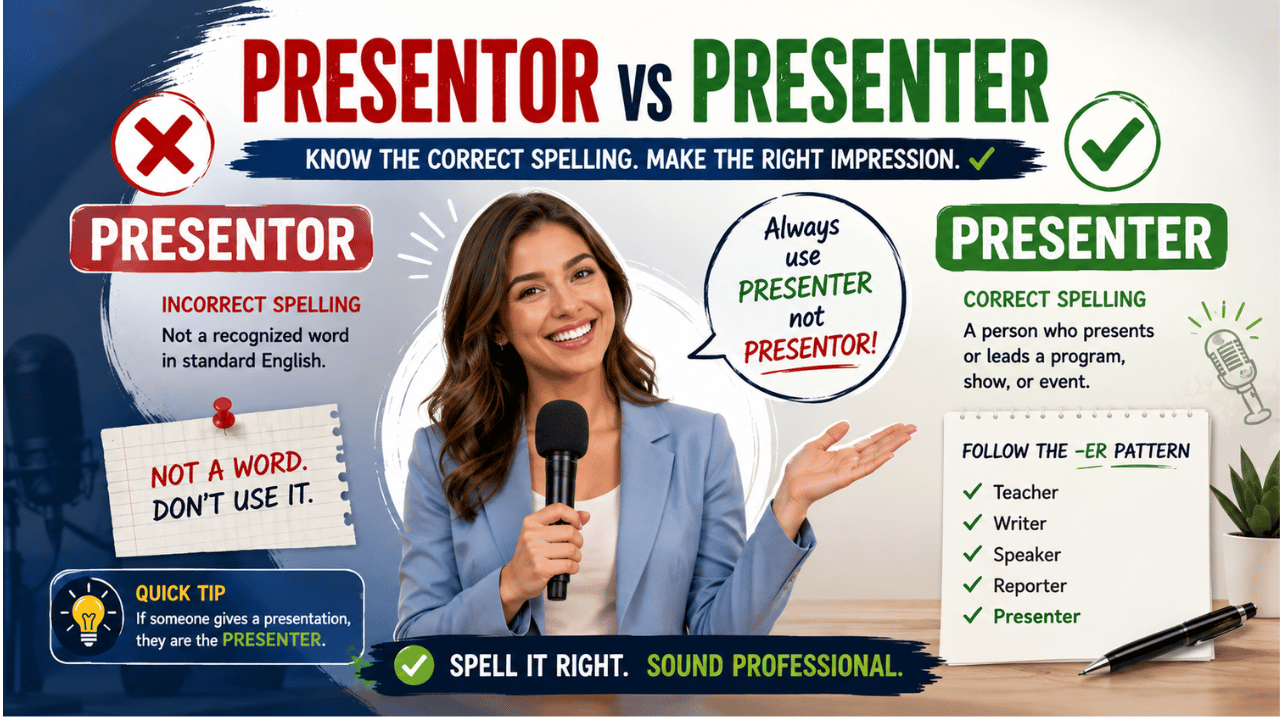
If you’ve paused during the process of composing a work email or a school assignment if you were meant to write presentor vs presenter, you are certainly not alone. This spelling question arises all the time, especially in formal writing (in work and education) where there is likely to be a lot of use of the word. In this post, we’re going to set that debate straight once and for all, tell you exactly why this confusion happens so often and give you some simple tips on how to remember the correct spelling forever.
The Correct Answer
Let’s get right to the point. When talking about presentor vs presenter, no matter the circumstance, whenever you are referring to this person within a presentation you’re always going to want it spelled as P-R-E-S-E-N-T-E-R. Even in standard English dictionaries, this is the only definition of “presenter,” encompassing anyone who presents information: a speaker at a conference, an anchor on TV or a student giving some kind of class presentation.
Only the one spelled “presentor,” is not a standard English word. As in keynote speaker, news anchor, or the best presentation ever given by a colleague with infinite patience who talked you through making it all work, “presenter” does not change.
Why This Confusion Happens So Often
If we want to see why so many people confuse presentor vs presenter, it comes down to a common pattern with English word endings. There are lots of job-related – or, indeed – role-based nouns ending with an -or in English: actor, director, editor and instructor. Since these common “-or” endings indicate that someone doing a certain job or activity, it can be easy to assume “presenter” works the same way.
English, however, has an enormous number of similar role-based nouns instead which end in −er such as teacher, writer, speaker and of course presenter. Such confusion is very normal, even among experienced writers, because there is no general rule that will tell you the ending for every word.
The Root Word Behind “Presenter”
If you want to know why the presentor vs presenter debate always trends towards the form ending in -er, it’s worth understanding how English usually derives this kind of noun. The term presenter is borrowed unabashedly from the verb present and uses the popular suffix “-er,” which typically indicates someone who does something (e.g., teacher, driver). This is the identical structure used to form nouns like teacher from the verb teach, writer from write, and speaker from speak.
I mean, the verb “present” already ends with a “t,” and so to form its comparative in a completely regular and unremarkable way – and not an oddball exception – it adds “-er,” yielding “presenter.”
The Mistake -What Due To Of The Problem With “-Or” Endings
One reason the presentor vs presenter confusion is so persistent, however, is because English actually uses “-or” endings on many function-based nouns (especially from Latin). Words like “actor, “director,” “editor,” and “instructor” follow this formula, and since they are often used in the same type of professional or academic context, it’s not surprising that anyone would be tempted to apply that same ending to the word presenter.
The honest answer is that there simply isn’t a completely consistent, cross-the-board rule for predicting whether an English word will end with “-er” or “-or.” The two patterns are common, and one usually has to learn and memorize the correct form on an individual-word basis, as it generally cannot be deduced from a reliable spelling pattern.
A Side-by-Side Comparison
Putting common “-er” and “-or” words together can help show the difference that you might not have thought of making an arbitrary distinction between presentor vs presenter as clear-cut.
| “-ER” Ending Words | “-OR” Ending Words |
|---|---|
| Presenter | Director |
| Teacher | Actor |
| Writer | Editor |
| Speaker | Instructor |
| Reporter | Supervisor |
If we look at this table, it is obvious that ‘presenter’ enjoys a family of other common -er words for roles or professions, and follows on from the same well-trodden path found in ‘teacher’, ‘writer’, and ‘speaker’.
Also Read: Pacient or Patient | Comming or Coming | FYP Meaning
Where You’d Most Likely See This Word Used

Considering how often this word crops up in various professional and academic contexts, knowing the difference between presentor and presenter will come in handy.
Business and Corporate Settings
The term “presenter” is used every day in workplace contexts, and anyone who presents information to colleagues, clients, or stakeholders is described as a presenter.
Television and Media
In broadcasting, the general term for someone presenting a television or radio program is presenter in British English (and more frequently host in American English).
Academic and Educational Contexts
Words students often hear in class presentations, either when presenting themselves or describing another student’s role during a group project.
Conferences and Public Speaking
The very word “presenter” is now routinely used across event programs, conference schedules, and speaker bios to refer to those giving talks, workshops, and keynote addresses.
Mistake in common sentences
The presentor vs presenter mix-up usually appears in written form where the word is used in something a little more formal, but without proofreading. A few common examples include:
- “Sarah is going to be the presentor for today.” (should be “presenter”)
- “Please welcome our keynote presentor.” (should be “presenter”)
- “The presentor was good at displaying the data.” (should be “presenter”)
The reason why knowing the correct spelling of this word matters more than it would for a strictly informal, conversational word (email list members do tend to notice and critique spelling in other contexts too) is that this word so frequently appears in formal business documents, event programs, and academic writing.
Simple Tricks for Remembering the Right Spelling
However, if you find yourself frequently needing to remember the difference between presentor vs presenter, a couple of mnemonic devices can engrave it in your brain forever.
- Connect it with the “teacher” and “speaker. It is also a good reason to train you, since these extremely common words have all the same “-er” that is shared with “presenter”.
- Remember the base verb “present.” It just works this way: -er added to literally “present,” which has the correct spelling even if it is an exception.
- Avoid the “-or” trap. You know that “director” and “actor” are in a whole different category than “presenter”
- Manually write it out a few times. Spelling it correctly repeatedly makes for a stronger long-term memory than reading the word passively.
- Double-check formal documents specifically. Since this word comes up throughout professional writing, you’ll want to do a quick proofread pass anytime you’re working on a doc, slide, or program that mentions a presenter.
Does Autocorrect Catch This Mistake?
For starters, yes, autocorrect catches “presentor” as soon as it’s typed because it isn’t an actual English word in most modern word processors, smartphones, and browsers. Yet, it has made the presentor vs presenter situation not feel quite so much of a daily battle like when notes were written by hand at school. Before word processors (read: any version without proofing), the problem was more severe.
Although, of course, you don’t have access to autocorrect in every writing environment – especially when using presentation software or creating printed documents and products that may have a misspelling go unnoticed until printing it out, publishing it to the web, etc. Knowing the correct spelling on your own is actually invaluable, particularly for anyone who creates event programs, business slides or formal written materials regularly.
Why This Still Matters In Getting It Right
Although it seems like a small detail, accurately converting between presentor vs presenter is a subtlety that can definitely impact the professional appearance of how your document reflects; whether this be a business, academic or events related subject. One single misspelling usually doesn’t ruin a good piece of writing, but errors for such a common formal context word as in conference programs, corporate slides or official bios can be more visible than an error in casual writing.
Spending time grappling with the messiness of why “presenter” goes “-er” and not “-or,” also builds a deeper core of spelling confidence that will lead to success in writing role-based nouns that pop up in your future.
Also Read: MYF Meaning in Slang | Clingy Meaning | HMU Meaning
Conclusion
The thing is, when it comes down to presentor vs presenter, the answer’s always going to be “presenter,” with an -er ending. The confusion is mainly born by Englishes inconsistent combination of the word endings -er and -or for an occupation, as in well formed words like director or actor one can understand the pattern to follow – but it reads poorly too for those who do not really know that by treating all endings as “-or” one would be most likely wrong. Knowing that a “presenter” is just a “present” plus “-er,” just like the words “teacher” and ” speaker,” makes it much easier to remember how to spell in your professional writing (and any kind of writing).
FAQs About Presentor vs Presenter
1. Is “presentor” ever correct?
No. The correct spelling is “presenter.”
2. Why does “presentor” mix with “presenter”?
People may incorrectly use the -or ending as in correction.
3. What is “presenter” derived from?
From “present” + “-er,” meaning one who presents.
4. Which words fit the same “-er” rules?
The models are teacher, writer, speaker, reporter.
5. Does spelling “presenter” correctly matter?
Yes. Proper spelling preserves a professional appearance in your formal writing.
3 thoughts on “Presentor vs Presenter: Which Spelling Is Actually Correct?”