
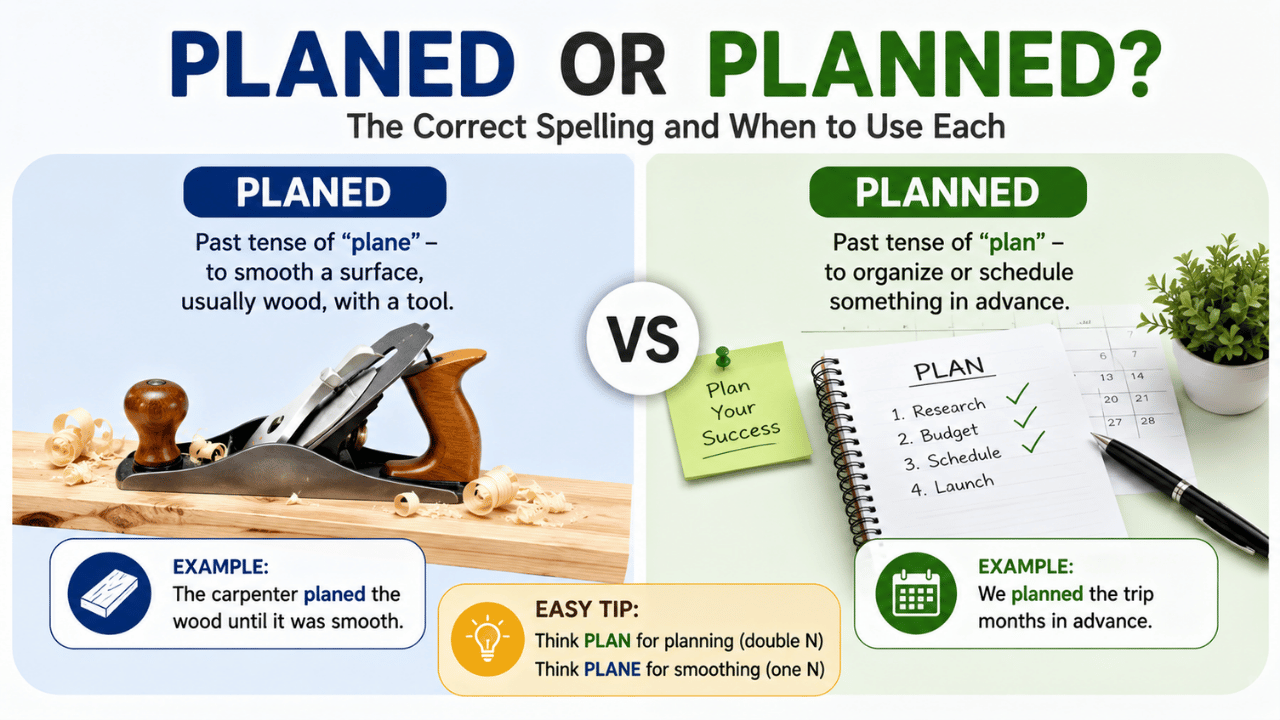
If you’ve ever hesitated mid-sentence debating whether you should type out “planed” or “planned,” then you’re waging a quiet battle of one of the sneakier spelling errors in English. These two words seem almost identical; they sound similar when pronounced very fast and yet mean different things. It is hard to blame you – getting it wrong is relatively simple, but you need to know where the words are coming from. We go through the proper spelling, what each word means, and quick tips to remember which form to use.
Planed or Planned: The Short Answer
Virtually across the board for all situations you will come into in everyday writing, “planned” is used here. This is the simple past of plan – to have arranged, organized, or prepared something in advance. The word ‘planed’ is, however, a much rarer one – quite a rare thing even as past tense of the verb ‘plane’, which means to smooth the flat surface of some material (typically with wood); that involves using a tool called a plane.
You want planned if you are talking about an event that is scheduled, in future preparation, or an outcome designed. When you are smoothing a wooden surface, or even less commonly something that glided or flied, you want planed.
Confusion Between These Two Words
The waffling here between planed or planned arises from the two terms looking somewhat similar, as well as sounding the same. They have the same root letters, differ only by a single “n”, and can be typed without even thinking about it, particularly in less formal venues like casual writing, texts, or e-mails. This is also where spell-checkers sometimes fail, since both words are legitimate in English, and the software has no way of knowing which one you meant from spelling alone.
To complicate matters, pronunciation also plays a role. In fast, casual speech, planed or planned can sound nearly identical, particularly from varying regional accents. This pair trips up even confident writers from time to time since most of us learn to differentiate homophones and near-homophones through rereading and writing, rather than sound.
Understanding “Planned”
The term planned is derived from the verb plan, meaning to think ahead and arrange an event, project, timetable, or outcome accordingly. It is one of the most frequent words in day-to-day English because of its universal applicability when it comes to both verbal and nonverbal conversations.
- This was not necessarily one which could have been planned or scheduled.
- We organized a surprise birthday party for her.
- The company scheduled the launch of its product for early spring.
- They planned to be on their way by 8 a.m., but the meeting went long.
- Every little aspect of the wedding was planned with the greatest care.
- The journey was meticulously planned months ago to score the cheapest flights.
Please note in all examples above, “planned” means preparation, scheduling or organizing something that has not happened yet or is said in the past tense to have been arranged beforehand.
Related Forms of “Plan”
- Plan (present tense verb or noun): “I plan to visit next week.” / “That’s a solid plan.”
- Planning (present participle): “We are planning the itinerary now.”
- Planned (past tense/past participle): “The trip was planned last month.”
- Planner (noun): “She’s using a planner to organize her schedule.”
Understanding “Planed”
The word planed is the past tense of plane, which is a verb that refers to woodworking or carpentry. Planing wood is when you smooth down all of the natural grains so that it is nice and flat and even if not a certain thickness, with either a hand plane or power plane.
Examples of “Planed” in a Sentence
- The carpenter planed the wooden plank until it was perfectly smooth.
- She planed down the edges of the door so it would close properly.
- The old floorboards were planed and refinished before installation.
- He carefully planed the surface of the tabletop before staining it.
“Planed” is a much rarer word in everyday parlance than “planned,” primarily because most people don’t talk about woodworking every day. To be fair, it is an entirely normal and correct word in carpentry, building, and other woodworking-related contexts.
Also Read: Bearly or Barely | Presentor vs Presenter | Pacient or Patient
A Less Common Use of “Planed”

On rare occasions, “planed” as in the sense of the path of something traveling smoothly through a body of air, like how an airplane planed along in flight (the frisbee planed across the yard before landing). This is a much rarer usage and more common with more descriptive or literary writing, but it’s worth being aware of nevertheless because you probably won’t use it too often.
Side-by-Side Comparison
| Word | Base Verb | Meaning | Common Context |
| Planned | Plan | To have organized or scheduled something in advance | Events, projects, schedules, goals |
| Planed | Plane | To smooth a surface, typically wood, with a tool | Woodworking, carpentry, construction |
Easy Tips to Distinguish Them
If you often confuse planed or planned, here are some memory tricks to help hang on to the correct spelling.
Consider the double “N.” The word “planned” has a double N, just like the simple future tense for form a past participle of the plan requires. If you are referring to the time of day or an occasion, double the N.
Connect “planed” to “plane.” Whenever you need the “one N” version, think of a carpenter’s plane taking shavings off a piece of wood since “planed” comes from “plane,” and plane is also the woodworking tool.
If it is a sentence that has to do with the arranging, preparing, or organizing of something, then you are nearly always going to want planned. Between planed and other surface types.
If in doubt, then assume planned. In most everyday contexts, however, planned is used much more often, so it’s the safer option unless you’re writing about woodworking or carpentry in particular.
Common Mistakes to Avoid
There are a few patterns that emerge when these two words get confused:
- For instance, writing “we had planed a trip” instead of the correct “we had planned a trip.”
- Correct: planed (for woodworking); incorrect: planned- e.g., “the wood was planned smooth”.
- This is the type of thing that spell-check will not find – both “too” and “to” are spelled correctly, but just used in the wrong context.
- Just trusting autocorrect will correct it, when in truth, predictive text only predicts the word it thinks is more frequently used, and at times by making the error worse rather than better.
Why Getting This Right Matters
Spelling errors that are subtly different, such as planed or planned can seem like minor slip-ups, but they are not a good look and can affect the way your writing is perceived, especially in professional or academic settings. An incorrectly used word can potentially send a reader off on a tangent, make him or her confused as to what you meant to say, or, unfortunately, it will give the impression of sloppy writing even if that is not your intention. In particular, this is true for emails, resumes, reports, and any language that requires using the written word to create credibility: small, easy-to-make mistakes will feel more glaring than in conversational speech.
Pause to check which of these words aligns more closely with what you mean – organizing something, smoothing a surface – and already is better make things clearer in the long run.
Also Read: Comming or Coming | FYP Meaning | HMU Meaning
Conclusion
The difference between planed or planned comes down to two entirely different root words with two completely different definitions. In most situations in daily language, you will use “planned” to refer to something that is set up ahead of time. Planed is a far more technical term, related to smoothing wood or similar surfaces primarily within a woodworking/carpentry context. Connect each word to its root – so plan for scheduled, and plane for smooth – then the distinction becomes far more memorable, and you’ll choose the right one with confidence every single time.
FAQs About Planed or Planned
1. When should I use “planed”?
Anything with a “planed”, which is used to smooth out surfaces, generally wood.
2. Why get confused with “planed” and “planned”?
They’re visually and phonetically similar – differing by a single letter.
3. Is “planed” a real word?
Yes. It is the past tense of “plane,” a tool used in woodwork.
4. Which is better: planed or planned?
The everyday English, ” planned ” is much more common.
5. Does autocorrect fix the mistake?
Not always, as both words are spelled correctly.
1 thought on “Planed or Planned? The Correct Spelling and When to Use Each”