
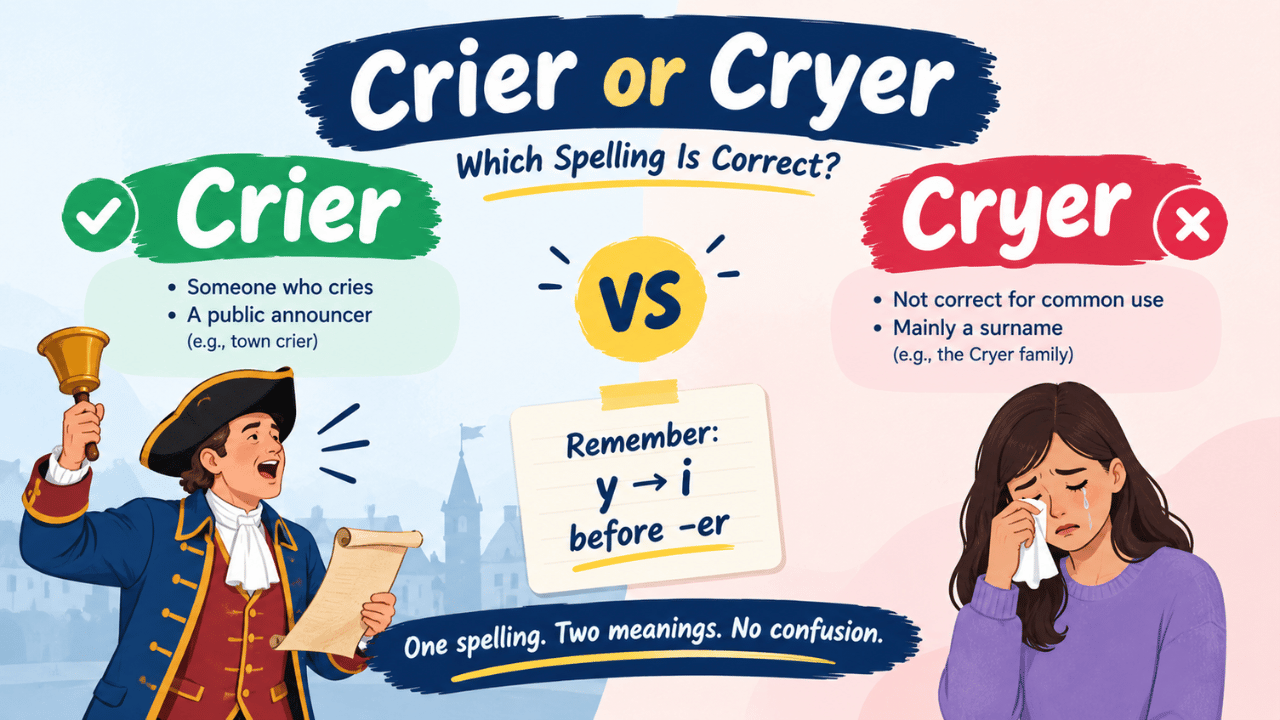
The trick with English spelling is that it sets a trap for you with words that sound the same but look different in print. One textbook example is the crier or cryer debate. It’s easy to see why so many writers pause in mid-sentence, as they can’t immediately decide whether to go with one of the other, since both are pronounced the same way. If you reached the office because you are solving the question once and for all, you opened the right article.
In short: “crier” is the standard, dictionary-approved spelling; while “cryer” is a substandard alternate that has fallen into disuse. However, this nuance is relevant because if you want to know why this confusion happens at all and where before a cryer makes the most sense. The crier or cryer question often comes up when writers are unsure whether the word should retain the original “y” from “cry” or change it to an “i.” Let’s break it all down.
The Quick Answer
Need the one-line version to take away: “crier.” It is the spelling recognized by all major dictionaries, and it is the one you will find in newspapers, novels, academic writing, and professional correspondence. “Crier” itself is not a nonsense word; however, it is the incorrect spelling for generic-noun Crier “one who cries; a public announcer.” The only actual use of it today as a proper noun is still that name, as in a surname.
As a reference point, when you’re caught in a debate between using crier or cryer, in the sense of an emotional context or for professional environments, choose wisely, and you’re always better safe with crier.
Why Do Both Spellings Exist?
To figure out the crier or cryer confusion, we have to look at the origin of that word. Just look at the word “Crier”, which derives from the verb “cry” + agent suffix “-er”, the ending in English used to denote a person who does something (in other words, someone who performs an action; see how “teach” becomes “teacher,” or “sing” becomes “singer”).
This is where the fun with spelling comes in, because there is a longstanding rule about how words that end in consonants followed by “y” change their “y” to an “i” before using some suffixes. Like the word “happy” turning into the word “happiness”, or even better, making it “can” into “carrier”. So, if I do the same with “cry,” that yields “cri” plus “er,” which equals echo, or (emphasis) crier. This isn’t an arbitrary exception to a rule; it’s a fully established spelling convention, and that’s what makes “crier” look, well, the way it does.
By contrast, “Cryer” is instinctively phonetically guided. The most common error comes from the fact that it sounds like “cry” and just with an “er” at the end attached to it. This is a completely reasonable and understandable guess, but it does not correspond with the grammar rule that gets applied here in English. Knowing what a crier or cryer is makes it easier to remember which spelling, because “crier” can mean someone who cries and one who proclaims information in public.
What Does “Crier” Actually Mean?
The word crier has two definitions which are closely related but distinguishable from one another, both of which are still fully in use.
Someone who cries. This is the broader, less technical version. It refers to a person, usually a The baby has always been a loud crier.
- She admitted she’s a crier during sad movies.
- He’s not usually a crier, but that speech got to him.
A public announcer (call from historical to “town crier”). Centuries ago, before we had newspapers, radio, or even the internet, communities used to employ a specific crier to walk around their town square and streets, ringing a bell as they called out news, royal announcements, or any type of local message.
- The town crier read the mayor’s proclamation aloud in the square.
- A court crier still formally announces the arrival of the judge in some legal traditions.
- Reenactors dressed as a town crier are a common sight at historical festivals.
Both meanings remain relevant today. The emotional (private) sense is attested everywhere in informal conversation, and the public-announcer (formal) sense survives only in ceremonial, historic, and heritage settings, plus occasional quantum-modern remnants like courtroom and civic speech.
What About “Cryer”?
Now if “crier” is indeed correct, does that mean “cryer” is totally wrong? Not so much; it’s that “cryer” is wrong as a common noun, but not a meaningless term.
In contemporary usage, “cryer” is most legitimately seen as a family name. There are also many real people with the last name Cryer, and in that usage, it’s a proper noun, not an error in grammar. Have you seen it somewhere in the form of public figures, characters from fiction or people you know that spell their family name this way?
Aside from proper names, you might see cryer in older publications, casual writing, or creative contexts where a writer is using it stylistically. However, in standard modern English, the cryer as in “the person who you see crying” or listing a public announcer is still considered more of a typo than an accepted variant.
This is a little different from other lookalike word pairs.example of this behavior in English. Consider the words drier and dryer, for instance: both spellings survived but with two separate meanings, one indicates something more dry, whilst the latter usually refers to the machine. Or how about “flier” and “flyer,” which continue to be interchangeable for many but now, too, both are accepted spellings. The crier or cryer pair that we won’t follow either of those paths. Basically, one spelling won out almost entirely and left the other behind in this meaning.
Also Read: Seal vs Seel | Presentor vs Presenter | Bearly or Barely
A Simple Memory Trick
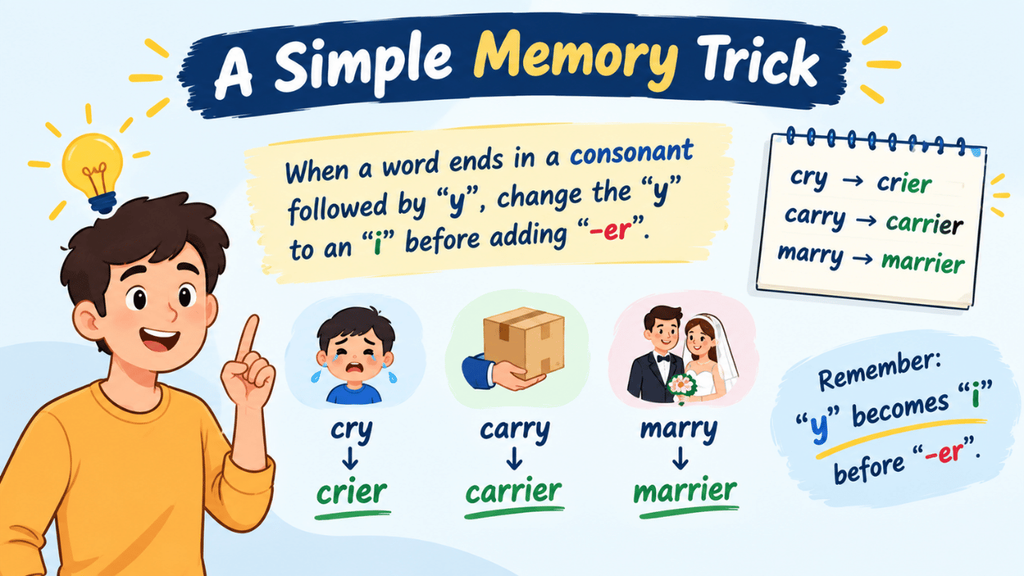
To permanently lock in the proper spelling, connecting crier to cries will do just that. A crier is one who cries· a carrier is one who carries· a marry-er marries (enters into marriage). Notice how each of these trades a “y” for an “i” before the ending. Eventually, if you recognize that pattern, the crier or cryer question holds no more confusion.
A further tip is to imagine the traditional of a village crier ringing a bell in a town square. The historical image is closely associated with the “crier” spelling as found in books, films and school text that helps suppress and solidify the correct version in your mind.
Common Mistakes People Make
As “crier” sounds exactly like “cryer,” typos are especially common even among confident, seasoned writers. A couple of patterns to note which you should look out for is
- Saying “the cryer announced the news” instead of the proper text “the crier announced the news.”
- Taking “cryer” to be merely a more contemporary, casual version of the word form when it’s actually the older, now-rareistic one.
- Confusing the personal surname of Cryer with a common noun, and presuming equivalency for both spellings outside of naming contexts.
- Working off of how a word sounds typing it out quickly and not verifying the spelling rule.
All of these can be avoided by getting into a habit to proofread. If you are ever in doubt when writing, a quick search or dictionary reference will confirm that “crier” is the version you should use for anything other than the name. For most definitions in modern English, only “crier” is a standard common noun and that crier or cryer confusion occurs mainly because the two sound identical.
Why Getting This Right Matters
This may not seem like a big deal, but minute detail normally makes the most impact on how sharp your writing looks. Whether writing up a school essay, professional email, fiction or website content would benefit from using “cryer” when “crier” belongs then otherwise strong writing suffers from a careless mistake. These details, while perhaps only subconsciously, are still noticed by readers and editors alike; correct, consistent spelling builds confidence in your writing.
Assuming you end up going with this as a subject (more so if coverage leans toward historical or ceremonial things, since crier shows up rather frequently in mentions of town criers, court criers, or auction criers that rhythmically call good bids). Those types of contexts make it important to get the spelling right, or else you risk undermining very good work.
Also Read: Planed or Planned | Pacient or Patient | Comming or Coming
Conclusion
There is, of course, no ambiguity to the crier or cryer dispute. Crier means both a public announcer (traditionally a town crier) and one who cries; the correct spelling in standard English is “crier” for both. The standard modern common noun is “cryer,” and, as a written word in 21st-century English, it’s not correct; it survives only functionally as an actual last name and occasionally appears within older literature.
Despite their differences, you know when to use one or the other because once you learn how “y” is dropped and turned into an “i” before certain suffixes, you won’t think a second time. The next time you have to write about someone whose tears flow copiously, or refer to the archetypal character who once bawled news in public squares, you’ll know which spelling this writer wants crying out.
FAQs About Crier or Cryer
1. Is “cryer” ever correct?
Not really. Crier is the correct word, and cryer is more of a surname.
2. Why crier is instead of cryer?
In English, the y is changed to i before suffixes -er, as in carry – carrier.
3. What does a “town crier” do?
In days gone by, there would be a town crier announcing news and other important information.
4. Do major dictionaries accept “cryer”?
No, “crier” is still the only widely accepted spelling for that sense of the word.
5. How I can remember the spelling in right way?
Link the word “crier” to the spelling of “i,” then with “cries.”