
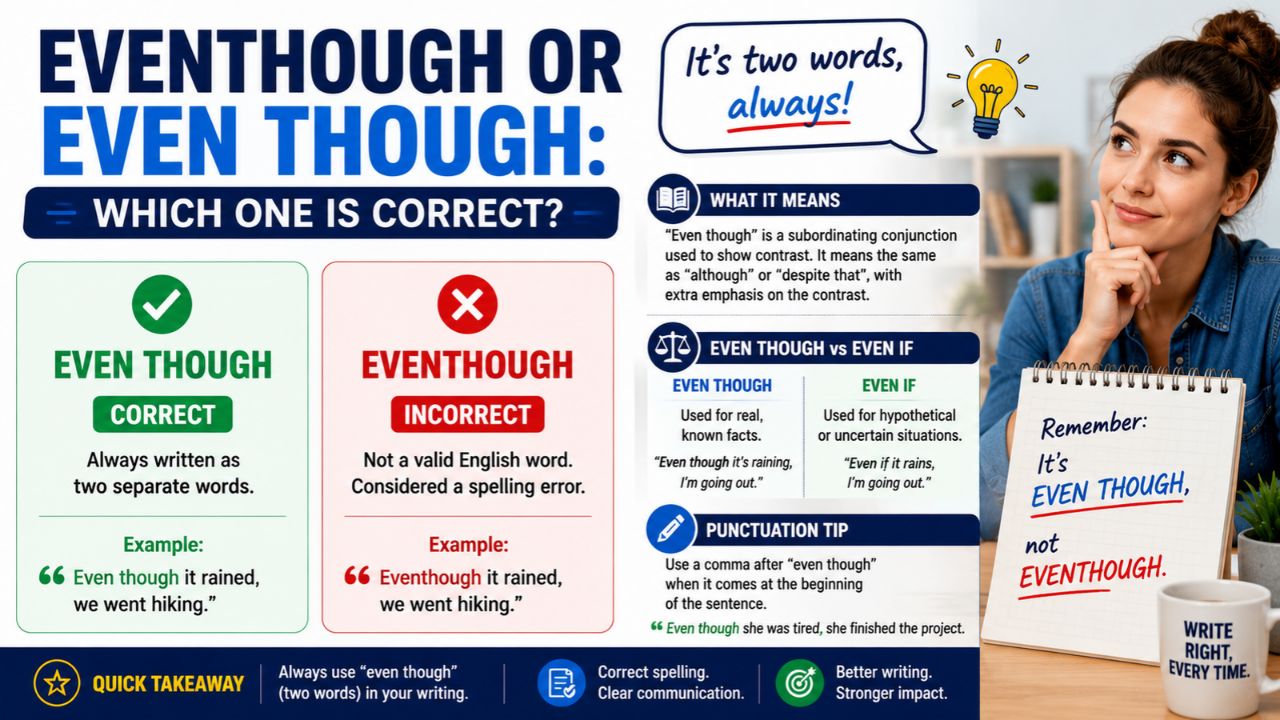
You’re in the middle of typing out a sentence, and you go to say “although” or “even though,” and your fingers stall. Is it one word or two? The eventhough or even though question stumbles up loads of confident writers, partly because the expression is so popular in spoken language and partly because it looks like one word. This guide gives you the answer once and for all, tells you why, then shows you how to use the phrase properly every time.
The Quick Answer
Even though, is always written as two separate words. So “eventhough” – this is not a valid English word. It won’t be in most dictionaries and style guides pretty much treat it as a spelling error.
Thus, in your writing, when trying to decide between eventhough or even though, the choice is easy: take the two-word form. This applies to emails, essays, fiction writing, social media posts, and formal reports.
| Version | Status | Example |
| Even though | Correct | “Even though it rained, we went hiking.” |
| Eventhough | Incorrect | “Eventhough it rained, we went hiking.” |
Why Does Eventhough Look Correct to So Many People?
Here are a couple of reasons one may confuse with eventhough or even though. English has a wide variety of compound words that begin as two distinct words and eventually coalesce. Consider “anyway,” “maybe,” or, worse, “cannot.” This occurs continuously; however, sometimes our placebo instinct tells us that any set of words in context used so frequently must have already merged.
Speech also plays a role. The expression out of mouth when we say “even though” comes together without a break between even and though, so we will read this phoneme as though they are one unit. When you write it as one word, I think that more accurately represents the sound.
At last, there is the impact of words that are indeed a single word and share similar meaning, such as “although” and “nevertheless”- Since the two words are written as a single unit, it would be easy to think that this sentence is formed in the same way: “eventhough”.
What “Even Though” Actually Means
“Although” is a subordinating conjunction. To put it simply, you want to relate two statements where the second one comes as a surprise or is in contradiction with the first. It basically means the same as “despite that” or “even though,” but with a bit more emphasis on the contrast.
This is how it works in sentences:
- “Even though she was tired, she finished the project.”
- “He kept smiling even though the news was disappointing.”
- “Even though the store was closed, we found what we needed.”
In both cases, the part after even though presents a true statement, and then you get a main clause that tells you that something happened anyway. And the crux of this phrase is: it always designates something that exists.
Also Read: Girlie or Girly | Eyeing or Eying | Crier or Cryer | Seal vs Seel
Why “Even Though” Is Two Words
The explanation lies in the way the phrase is stored. Here, “even” is an adverb that adds emphasis and “though” is a conjunction introducing contrast. They drive distance together, are sometimes treated as one word, but English has never run them together into a single unit the way it has with “although,” which is obviously two words (all + though).
Linguists have long bemoaned that spelling conventions are as a rule set by historical circumstance rather than by reason. In the course of hundreds of years, although was regularized to one word, whereas even though is still written as a two-word phrase. There is no universal rule that dictates this; it’s just how the language developed.
The answer to the eventhough or even though question is always so clear: one of them is never a standard form.
Even Though vs Even If
A frequent companion question is the difference between even though and even if. These two phrases look alike, but they mean different things.
Even though is for something actually true; even if is a hypothetical or uncertain condition.
| Phrase | Used For | Example |
| Even though | Real, known facts | “Even though it’s raining, I’m going out.” (It is raining.) |
| Even if | Hypothetical situations | “Even if it rains, I’m going out.” (It may or may not rain.) |
If you mix these two up, it can alter the sentence dramatically. If you say “I will stay even when I’m late” you are confirming that you are too late. Saying, “Even if I am late, I will stay,” is the possibility.
Even Though vs Although vs Though
These three words coincide, but their feel and placement are not always exchanged for one another.
Although. It is a word that basically functions in the same way as “even though”, but without as much emphasis. “It was cold outside, but we stayed outside to do it.”
Though. This could be before or after a sentence. It was freezing but we stayed rain. You can also have it at the end: “She was cold. We stayed outside, though.”
Even though. This brings importance, and this is typically the strongest of 3. “We remained outside despite the cold”
Two-word contrast forms In situations where you’re tempted to say eventhough or even though, note that the right two-word form is a member of exactly this family of contrasting words, so picking it over the others is simply about how emphatically you wish to relate the contrast.
Punctuation Rules for “Even Though”
The placement of the clause is crucial for whether you need a comma or not.
For sentences that start with “even though,” a comma should follow:
- “Even though he studied hard, he didn’t pass the exam.”
When the “even though” clause is in second place, you typically do not need a comma:
- “He didn’t pass the exam even though he studied hard.”
When you write on a regular basis, this is one of the most practical tips I can give because commas will be misplaced around this phrase almost as often as there are one-word spelling errors.
Common Mistakes With “Even Though”
And aside from the eventhough or even though spelling mistake, there are a variety of other mistakes that show up again and again.
- Using “even though” with “but.” It is not necessary to write, “although it was late, we continued. Already this phrase indicates a contrast, hence no “but”.
- Confusing it with “even if.” As discussed above, the two phrases have different meanings.
- Writing it as one word. This is the most common mistake, and this guide revolves around it.
Mistaking post-comma dates. A comma should come after the clause when it is ancient,
Using “Even Though” in Different Types of Writing
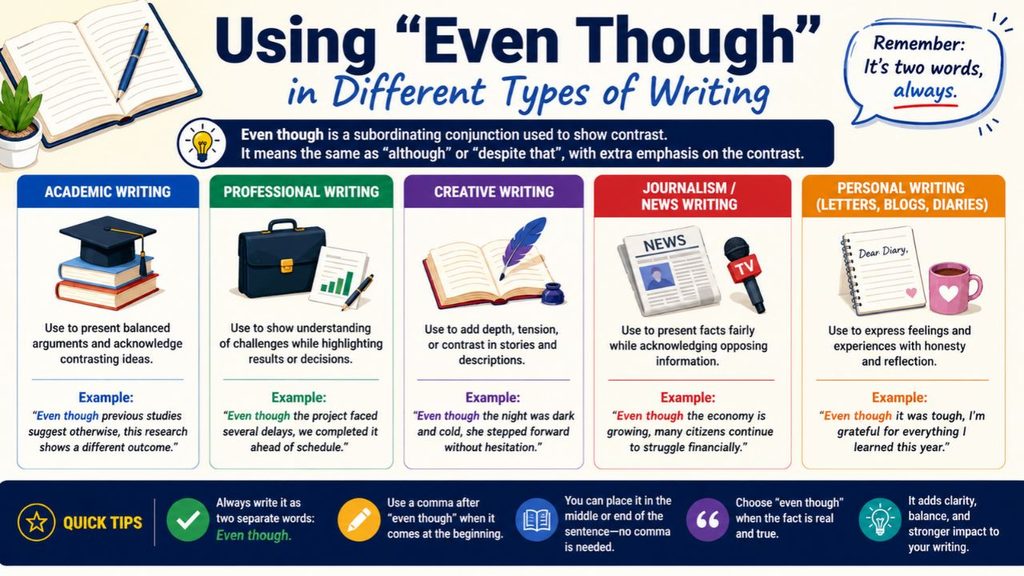
This phrase used, in almost all writing styles, has a tone but it can change the tone based on context.
Even though is what you need to say later on in emails and workplace messages when you want to acknowledge a constraint, but keep going anyway.For example: “Even though the deadline is tight, we can deliver the first draft by Friday.” Sounds prestigious, confident and unambiguous.
If you’re writing a more formal paper like an academic essay then useful for showing the opposite argument first. While critics argue otherwise, such observations appear to lead to a different conclusion. In this structure, you have demonstrated that you’ve taken other perspectives into account.
As for storytelling and fiction, it is used for providing emotional contrast. “I had the answers, but I was quite” These few words will indicate an inner conflict within a character without exposition
As in loose usage while talking and texting, this is exactly where the one word typo steps into the scene. It often reveals itself with a quick look before you click send.
If you get which word one is correct for all of these contexts thus, when writing for whoever, you can write without pausing or second-guessing.
An Easy To Remember Way to Easily Recall the Rule
If eventhough or even though gives you problems in the moment, try this: Treat “even” and “though” as two separate words that just so happen to work together, like “as well,” or “in spite.” Neither of those is written as one word, and the same goes for “even though.”
One additional helpful trick is to see if the sentence still makes sense when you substitute that phrase for “even though.” If it still makes sense, you are using “even though” correctly and should write it as two words.
Why Getting This Right Matters
When a reader sees “eventhough” in a professional email, on a cover letter or in an article they have paid to read (because if the website is not charging for access, it is running advertising as revenue), their impression of your attention to detail is predictably diminished.
The eventhough or even though distinction is a quick, low-effort improvement that adds to your writing each time you write, good for students, content creators, and professionals alike.
Also Read: Bearly or Barely | Presentor vs Presenter | Comming or Coming
Conclusion
The eventhough or even though question has an easy, rules-based answer: It must be “even though,” always two words and never a single word. In contrast, eventhough is another frequent misspelling that has never made it anywhere near standard English. Understanding that the phrase functions as other two-word connectors, through the appropriate punctuation pairings, and differentiating between it and “even if” will allow its use in any environment.
So, when you get to that stutter in the sentence next time, you already know what to write.
FAQs About Eventhough or Even though
1. Is “eventhough” ever correct?
No, “eventhough” is not correct – even though this is correct.
2. Is a comma necessary before but even though?
Not, of course, when the clause is at the end. Add a comma if it begins the sentence.
3. What is the difference between ‘even though’ and ‘even if’?
Even though refers to something that is true, while even if refers to a hypothetical situation or one that is uncertain.
4. Why do people write the word eventhough as one word?
It sounds easy to pronounce and is also similar in assonance with the word context, including words like “although”.
5. What is the way to memorize its Correct Spelling?
Note that even and though are still separate. That phrase can also be swapped with “even though.”