
A very small distinction in only one letter makes a big impact on what we see in our email, social media, school papers, and products we list online. People of all levels have trouble with “less than” or “less then,” and this is primarily due to the fact that “than” and “then” appear and sound so similar.
This guide provides an explanation of which term is correct, why people often make mistakes when using these terms, and how to avoid making those mistakes again.
The Quick Answer
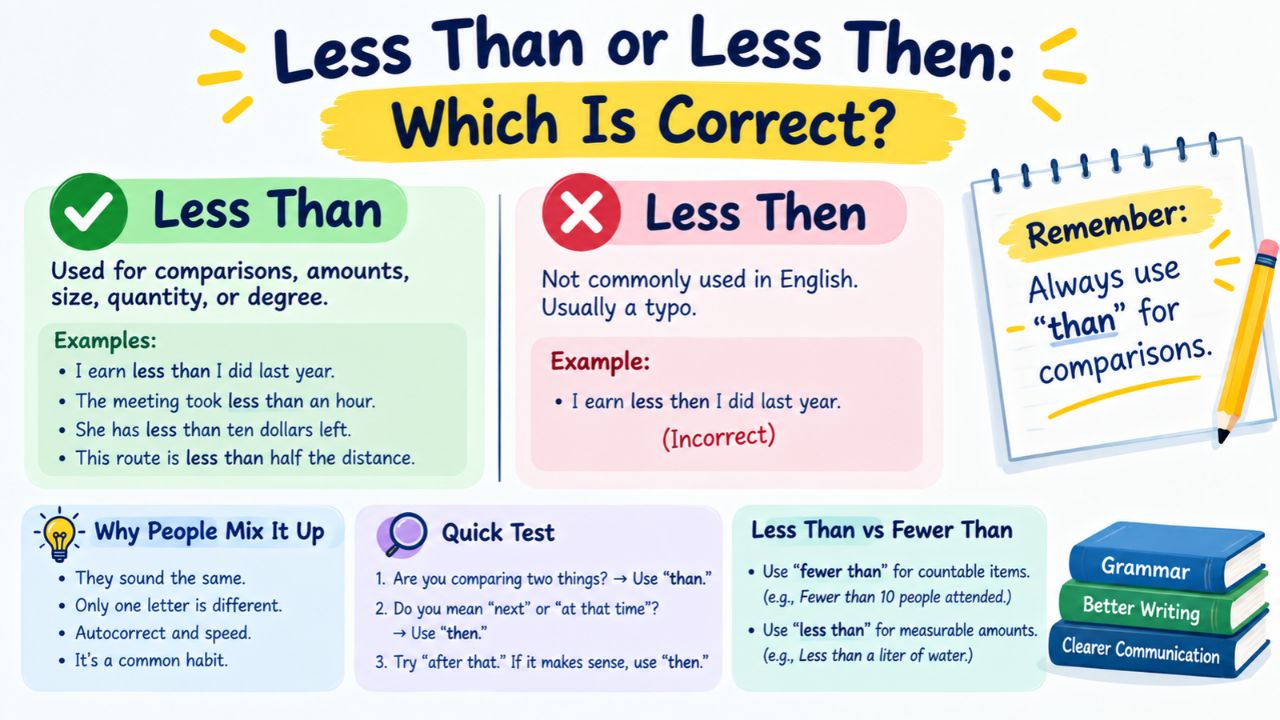
“Less Than” is the proper term to describe differences in amount, size, quantity, or degree. The phrase “Less Then” is not commonly used in the English language. When this occurs in writing, it is most often a result of a typo.
Therefore, when you are choosing whether to use “less than” or “less then” in a comparison, the correct response is always “than”. “Then” has a completely separate function; it relates to time and sequence.
| Phrase | Status | Example |
| Less than | Correct | “I earn less than I did last year.” |
| Less then | Incorrect | “I earn less then I did last year.” |
Why “Than” Is the Right Word
The way you use the two small words “less” and “than” is very simple once you know what each of those little words does.
The word “than” is used in comparisons. To connect two ideas that are being compared. Examples include: “taller than,” “better than,” “more than,” and “less than.” Whenever there is a comparison, “than” is the appropriate word.
The word “then” can be used as an adverb of time. The function of this word is to identify a particular point in time or a step within a series. For example, “First we ate, then we walked.” “If it rains, then we’ll stay in.” In addition, the use of “then” indicates either when something occurs or the chronological order in which events occur.
As a comparative term, the word “less” goes hand-in-hand with the word “than.” They are used together to express the idea that one quantity is less than another.
What “Less Than” Means
The expression “less than” indicates that an amount, degree or size of something is less than that of another. This is used in many daily activities.
- “The meeting took less than an hour.”
- “She has less than ten dollars left.”
- “This route is less than half the distance.”
- “He was less than thrilled about the news.”
Each of the examples illustrates the comparison of one thing to another thing (a second item), or to a certain amount (a limit). These can be used to describe the exact number, a broad quantity, or a quality. For example, the phrase “less than happy” describes the quality of being unhappy.
Also Read: Eventhough or Even Though | To Many or Too Many | Eyeing or Eying
Why People Mix Up “Than” and “Then”
The confusion behind less than or less then has a few simple causes.
They sound the same. When people talk casually, the vowel sounds in “than” and “then” tend to merge into one another, particularly if they are talking very fast. Since we spell words based on how we hear them, the incorrect letter gets written down.
Both of these words are very similar. They only differ by one letter in the middle. Because of this, it is easy to make a typing mistake.
Autocorrect and speed. A phone keyboard will usually allow “then” when used in “less then” as it is a correctly spelled word. However, since spell-checking software recognizes words based upon their spelling and not their meaning or usage within a sentence, this type of error often goes unnoticed.
Habit. People who use the phrase “and then” often times can slip into using the word “then” when it is not appropriate.
A Simple Test to Check Your Sentence
If you’re ever unsure between less than or less then, try this quick test.
Ask whether you are comparing two things. If yes, use “than.”
Ask whether you mean “next” or “at that time.” If yes, use “then.”
You can use “after that” in place of the word “then.” If the sentence remains coherent, then “then” is the proper choice. If the sentence becomes incoherent, then “than” is the appropriate choice.
| Question | Use “Than” | Use “Then” |
| Are you comparing two things? | Yes | No |
| Does it mean “next” or “after that”? | No | Yes |
| Does it describe time or order? | No | Yes |
| Does it follow words like “more,” “less,” “better”? | Yes | No |
This test can help you find and fix the “less than” or “less then” issue in each questionable sentence.
Less Than vs Fewer Than
A second popular question about using “less than” or “fewer than” is the traditional rule that applies to these terms.
Use “fewer than” when referring to items that can be counted as individual units. For example, “Fewer than 10 people attended.” “She had fewer than 5 errors.”
When referencing quantities that can be measured, but not counted (i.e., less than a liter of water), use “less than.” For example: “Less than an hour of time.” “Less than enough money.”
People will generally allow you to use “less than” in all types of writing. However, if you want your written work to appear more professional, it is best to follow the conventional usage rules.
Understanding this extra rule allows for easier use of “less than” or “less then” in any context, as you are able to better understand what each word does.
Common Mistakes With “Less Than”
A few additional errors occur on a regular basis beyond the “less than or less then” confusion.
- Writing “less then” in a comparison. This is the typo this guide is built around.
- Using “less than” with countable nouns in formal writing. “Less than five people” should usually be “fewer than five people.”
- Writing “lesser than.” In most cases, “less than” is the correct comparison. “Lesser” works as an adjective, as in “the lesser of two evils.”
- Confusing “less than” with “no more than.” The two phrases overlap but aren’t identical. “Less than ten” excludes ten, while “no more than ten” includes it.
Examples of Correct Usage
Looking at sentences side by side makes the rule easier to remember.
- “The package weighs less than two kilograms.” (comparison)
- “We finished the project, and then we celebrated.” (sequence)
- “It costs less than I expected, so then I bought two.” (comparison, then sequence)
- “Fewer than twenty people responded, which is less than we hoped.” (both rules together)
In the last example, each word performs a separate function within the same sentence.
Less Than in Maths and Programming
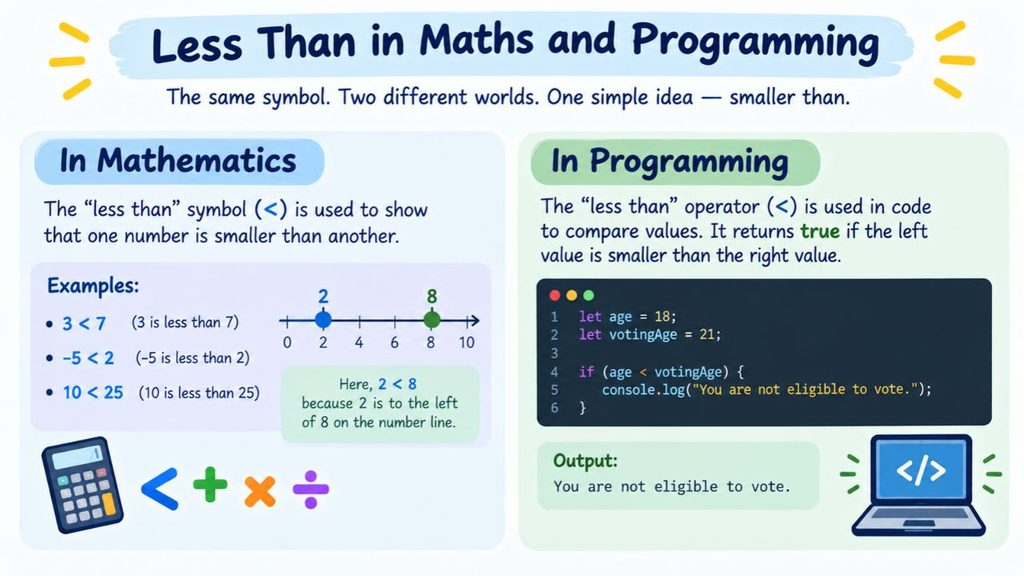
Less than is defined mathematically. The symbol < represents “less than,” as in 3 < 5. This represents that the value on the left is less than the value on the right. Another related symbol, ≤, is defined as “less than or equal to.”
In both computer programming and spreadsheet applications, the same concept exists through the use of comparison operators. For instance, the condition “x < 10” evaluates whether a specific value is less than 10. Additionally, the word “then” is used in conjunction with these conditions in statements such as “if x is true, then y.” Both of the words are being utilized in distinct roles within each of the two types of applications. The comparison operator “less than” is evaluating the relationship between two variables, while the word “then” indicates the subsequent action that should occur based upon the outcome of the evaluation.
The fact that both terms are included in the single logical statement reminds us that the two terms serve completely different functions.
Where You’ll See “Less Than” in Real Life
This phrase is used far more often than most people realize. Store signage advertises products “for less than five dollars.” Delivery services guarantee that packages will arrive “in less than two days.” Terms and conditions specify restrictions such as “amounts less than the minimum.” Recipes state that “less than a teaspoon” of a strong ingredient should be added to a dish. Fitness tracking devices celebrate when runners finish their run “in less than thirty minutes.”
Because the use of the term “less than” is so frequent, it makes it easier to spot errors. An error such as using the words “less then” on a sales page or in a notice will hurt what would otherwise be a professional message. Checking whether you need to use “less than” or “less then” before publishing is one of the quickest ways to verify your quality.
Why Getting This Right Matters
Little mistakes can make great writing weaker over time. When a reader sees “less then” in a job application, a report, or a published article, they will probably think a little less about the author’s attention to detail, even if the rest of the work was done well. For students, professional writers, and people creating content, learning how to use less than or less then is an easy way to improve.
In addition, it provides some clarity. Most of the time, your reader will be able to figure out what you intended to say; however, if you choose the incorrect term, your reader will stop and think about it. Writing that is well done should never cause a reader to pause for the wrong reason.
A Memory Trick to Lock It In
A simple way to remember the difference between than and then is to look at the first letter of each. Than begins with a ‘T’ and ends with an ‘n’, as does the word comparison. Therefore, if you are making a comparison, you should use Than. On the other hand, Then begins with a ‘T’ and ends with an ‘n’, as does the word Time. Therefore, if you are discussing time, you should use Then.
The other way to think about this is that the word “less” is always looking for something to compare against and the word it uses to do that is “than.”
Also Read: Girlie or Girly | Crier or Cryer | Seal vs Seel | Planed or Planned
Conclusion
There is no doubt about whether to use less than or less then; it is very straightforward. “Less than” is used when making comparisons and “then” is used to show a relationship in time or order. Once you can recall that “than” is used to connect two items that are being compared, and “then” is used to demonstrate what follows after, selecting the correct form of the word will become second nature. Try using some of the short tests in this article to help solidify your understanding of these terms, as well as keeping the “a” and “e” memory trick in mind to ensure that you do not make this error again.
FAQs About Less Than or Less Then
1. What is the difference between “than” and “then”?
“Than” compares things, while “then” refers to time or sequence.
2. Is it “less than” or “fewer than”?
Use “fewer than” for countable items and “less than” for measurable amounts.
3. Is “lesser than” correct?
“Less than” is the usual way to compare things. “Lesser” is typically used when you are describing a thing (as in “the lesser option”).
4. Why does autocorrect miss “less then”?
“Then” is an actual word; therefore, spell-check programs may not be able to identify that it was used improperly within the given context.
5. How can I remember which word to use?
Use “than” for comparisons and “then” for time or sequence.